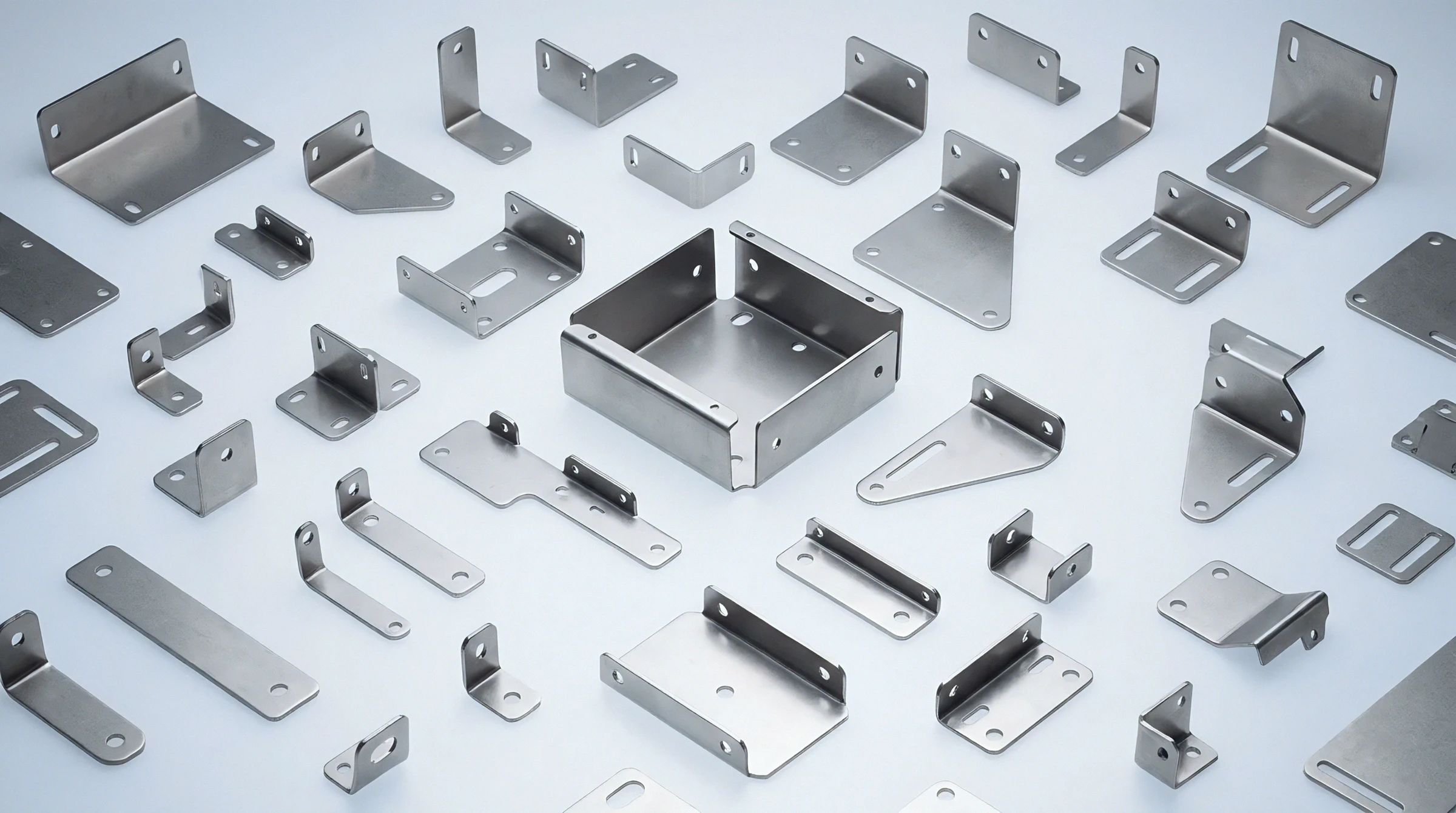
A strip of annealed 316L can stretch to about one and a half times its length before it breaks: Cleveland-Cliffs prints 55 % elongation in 50.8 mm (2 in) for the grade. Lay the same strip across a press brake die and it pushes back. Euro Inox puts the bending force of austenitic stainless at roughly 50 % above that of a carbon steel of similar thickness, and advises overbending by about 5° so that a 90° flange does not open up once the punch lifts.
That pairing of a very ductile metal with a stubborn one runs through every step a 316L sheet part goes through. The laser cuts it, the brake forms it, the welder joins it and a finisher restores its surface, and each step has a published number behind it.
What 316L Sheet Adds Over 304L in a Cut and Bent Part
Type 316L is Type 316 with the carbon ceiling lowered from 0.08 % to 0.03 % by weight. Both carry 16.0 to 18.0 % chromium, 10.0 to 14.0 % nickel and 2.00 to 3.00 % molybdenum, according to the Cleveland-Cliffs product bulletin for the two types. The low carbon matters at the weld: it keeps chromium carbides from forming in the heat-affected zone, and that precipitation is what opens a weld to intergranular corrosion.
Type 304 and its low-carbon twin 304L have no molybdenum, with 18.0 to 20.0 % chromium and 8.00 to 12.00 % nickel. The molybdenum is what separates the two families in service. Cleveland-Cliffs credits it with better chloride resistance than 304 and with acceptable protection against pitting in marine atmospheres. Euro Inox draws the same line for buildings: 316 (EN grade 1.4401) for coastal or heavy industrial sites, 304 (1.4301) for less demanding exteriors.
On the bench, a 316L sheet and a 304L sheet look the same, cut the same and bend about the same. The difference is corrosion margin, and it shows up only when chlorides, a coastal site or a cleaning chemistry enters the part’s life.
316L is 316 with carbon at 0.03 % maximum, so it can be welded without annealing for intergranular corrosion. The molybdenum, 2.00 to 3.00 %, is what 304L lacks, and it is the reason to specify 316L at all.
Composition and Mechanical Properties of 316L Sheet in Metric and Inch Units
Cleveland-Cliffs prints one row of typical room-temperature properties for 316 and 316L together: 627 MPa (91 ksi) ultimate tensile strength, 290 MPa (42 ksi) 0.2 % yield strength, 55 % elongation in 50.8 mm and Rockwell B 79. The bulletin lists 304 and 304L separately, and Table 1 puts the four grades side by side.
| Property | 304 | 304L | 316 | 316L |
|---|---|---|---|---|
| Carbon, max, % by weight | 0.08 | 0.03 | 0.08 | 0.03 |
| Chromium, % by weight | 18.0 to 20.0 | 18.0 to 20.0 | 16.0 to 18.0 | 16.0 to 18.0 |
| Nickel, % by weight | 8.00 to 12.00 | 8.00 to 12.00 | 10.00 to 14.00 | 10.00 to 14.00 |
| Molybdenum, % by weight | none listed | none listed | 2.00 to 3.00 | 2.00 to 3.00 |
| Ultimate tensile strength | 655 MPa (95 ksi) | 655 MPa (95 ksi) | 627 MPa (91 ksi) | 627 MPa (91 ksi) |
| 0.2 % yield strength | 290 MPa (42 ksi) | 276 MPa (40 ksi) | 290 MPa (42 ksi) | 290 MPa (42 ksi) |
| Elongation in 50.8 mm (2 in) | 55 % | 55 % | 55 % | 55 % |
| Rockwell hardness | B 84 | B 82 | B 79 | B 79 |
Two cautions come with the table. First, these are typical values from the maker’s bulletin, and the bulletin names ASTM A240 as the specification for 316L sheet and strip, so the minimums a mill certificate is read against sit in A240 and not in the table. Second, the 316 and 316L figures share a row, which means no number in the bulletin separates the two grades. Carbon and its welding consequence do that.
The sheet keeps most of its strength at moderate heat. Table 2 reads the same bulletin at temperature, with the physical constants a fabricator needs for distortion and weld planning.
| Temperature | Ultimate tensile strength | 0.2 % yield strength | Elongation in 50.8 mm |
|---|---|---|---|
| 204 °C (400 °F) | 558 MPa (81 ksi) | 241 MPa (35 ksi) | 51 % |
| 316 °C (600 °F) | 538 MPa (78 ksi) | 214 MPa (31 ksi) | 48 % |
| 427 °C (800 °F) | 524 MPa (76 ksi) | 190 MPa (28 ksi) | 47 % |
| 538 °C (1000 °F) | 483 MPa (70 ksi) | 165 MPa (24 ksi) | 44 % |
| 649 °C (1200 °F) | 393 MPa (57 ksi) | 145 MPa (21 ksi) | 40 % |
The same bulletin gives a density of 8.03 g/cm³ (0.29 lb/in³), a modulus of elasticity of 193 GPa (28.0 x 10³ ksi) in tension and a thermal conductivity of 16.2 W/(m·K) at 100 °C. The coefficient of thermal expansion is 16.0 µm/m/K from 0 to 100 °C, rising to 17.5 µm/m/K over 0 to 538 °C. Take a 1,000 mm edge heated by 10 K and it grows 0.16 mm.
Read as fractions of the room-temperature values, the strength falls slowly. At 538 °C the typical tensile strength of 483 MPa is 77 % of the 627 MPa at room temperature, and the 165 MPa yield is 57 % of 290 MPa. Near 649 °C, they fall to 63 % and 50 %.
The bulletin also lists stress rupture data: 248 MPa (36.0 ksi) for rupture in 1,000 hours at 593 °C (1,100 °F), 193 MPa (28.0 ksi) in 10,000 hours and 172 MPa (25.0 ksi) in 100,000 hours at the same temperature. A heated 316L enclosure, a furnace pan or an exhaust part is therefore judged on those tables and not on the room-temperature row, and a drawing for hot service says the temperature and the life.
Sheet Thickness and Width Limits Listed by the Mill
Cleveland-Cliffs lists 316 and 316L from 0.25 mm to 4.76 mm (0.010 to 0.1874 in) thick and up to 1,219 mm (48 in) wide, and refers other sizes to its sales staff. Its 304 and 304L range runs further, to 6.35 mm (0.25 in) and 1,524 mm (60 in). So a 5 mm part in 316L is already past the range of this maker’s sheet, where plate with different tolerances begins.
Other mills publish other ranges, and a laser has its own ceiling. ISO 9013 covers laser cuts from 0.5 mm to 32 mm, which is a far wider window than the sheet a brake can form. The part’s thickness is then set by the forming step, not by the cutting step.
Bending 316L Stainless Sheet, Work Hardening and Springback
Austenitic stainless hardens as it deforms. Cleveland-Cliffs notes that 316 and 316L, with their higher nickel content, work harden at a lower rate than 304, and that in the annealed condition they are very ductile and can be roll formed, deep drawn and bent. Annealing restores ductility. The bulletin gives the cycle as heating to 1,038 to 1,149 °C (1,900 to 2,100 °F) followed by a quench that cools the sheet quickly, and says severely formed parts should be annealed to relieve stress.
Euro Inox adds the shop-floor side. Press brake force climbs by about half over carbon steel of the same thickness, and springback is real. The roughly 5° overbend is a starting figure for the family, and thickness, bend radius and die opening then move it. Euro Inox also insists on tools kept for stainless only, since carbon steel particles can contaminate the stainless surface.
Three further points follow from the same sources.
- A part that is bent twice in the same area carries the hardening of the first bend into the second, so a tight relief or a repeated hem is a place to ask for a trial piece.
- The material may become slightly magnetic when highly cold worked, per Cleveland-Cliffs, so a magnet that sticks to a bend does not prove the grade is wrong.
- Annealed material is close to non-magnetic, with a permeability of 1.02 maximum at 200 oersteds in the bulletin, so a strong pull on an unformed sheet is a different question from a pull on a bend.
Plan for about 5° of overbend as a starting point on 316L, tool the bend on stainless-only dies, and treat the first formed piece as the real measurement.
Laser Cut Edges on 316L Sheet
ISO 9013 describes a cut by two measured values: the perpendicularity or angularity tolerance u, in millimeters, and the mean profile height Rz5, in micrometers. Each has numbered ranges, and each depends on the cut thickness a. For range 1 the standard sets u at 0.05 + 0.003 a and Rz5 at 10 + 0.6 a, so a 2 mm sheet in range 1 allows 0.056 mm of squareness error and 11.2 µm of profile height.
The standard measures on brushed cuts free of oxides, away from the start, the end and the piercing area. Under 2 mm of thickness it says the measuring method for u has to be agreed separately, which is where most thin 316L parts sit. A drawing that calls out a cut class without an agreed method for thin sheet has not said what will be checked.
Heat adds a second effect. ISO 9013 states that material grade and sheet temperature against machine temperature need to suit the elongation or contraction of the sheet as residual stress relaxes during cutting, and that the dimensional classes can be reached only on serviced machines with trained operators. With 316L’s expansion coefficient of 16.0 µm/m/K, a long, narrow part cut in one hot pass is the shape that moves.
Welding 316L Sheet and the Heat Tint That Follows
Cleveland-Cliffs rates the austenitic family as weldable by common fusion and resistance methods, and lists 316 and 316L as poorer than 304 and 304L. The higher nickel asks for a slower arc travel speed and more care to avoid hot cracking, and the weld deposit needs some ferrite. For filler the bulletin names AWS E/ER 316L and 16-8-2 as the common choices.
Euro Inox flags the distortion side. Stainless expands more and conducts heat less than carbon steel, so a seam heats a narrow strip and pulls the sheet toward it. TIG, plasma arc, MIG, shielded metal arc and resistance welding all suit the grade, and the choice of finish affects how a seam is cleaned, because directional finishes have to be restored at welded junctions.
ISO 5817 gives the acceptance side for fusion welds in steel, nickel and titanium alloys on material 0.5 mm and thicker. Its table lists temper colors, the visible oxide film left by heat, and spatter, and for both it says acceptance depends on the application, for quality levels B, C and D alike. In other words, the standard does not grade heat tint. A 316L part that has to look uniform, or has to resist chlorides, needs the tint requirement written on the drawing, with a cleaning step such as pickling or passivation agreed with the supplier.
Thin sheet is where the standard’s numbers get small. For material 0.5 to 3 mm thick, ISO 5817 allows linear misalignment between plates of 0.1 t + 0.2 mm at level B, 0.15 t + 0.2 mm at level C and 0.25 t + 0.2 mm at level D, where t is the thinner plate. On 1.5 mm 316L that is 0.35 mm, 0.43 mm and 0.58 mm. The same range allows no surface pores at levels C and B and no continuous undercut at level B, so a level B seam on 1.5 mm sheet is a seam with nothing to grind away.
- Quality level B in ISO 5817 may need extra processing such as grinding or TIG dressing, according to the standard’s introduction.
- Any acceptance of spatter or tint is a drawing note, not a default.
- A weld on thin sheet is judged on its own, since the standard says different quality levels can apply to different joints in the same product.
Surface Finish and Corrosion Limits to Put on the Order
Most 316L sheet leaves the mill as 2B, cold rolled, heat treated, pickled and skin passed. Euro Inox calls it the most widely used finish, with a smooth, reflective gray sheen, and its roughness note puts typical Ra for 2B in the 0.30 to 0.50 µm range. The designation names a process, though, and the same note warns that two suppliers can ship noticeably different roughness under one name. Ra ≤ 0.5 µm and Ra max 0.5 µm are different requirements, since the first allows 16 % of readings above the value and the second allows none.
Chemical limits come with the same caution. Cleveland-Cliffs says 316 and 316L are useful in sulfuric acid at concentrations below 5 % up to 60 °C (150 °F) and resist acetic, formic, phosphoric and tartaric acids. Those statements describe the alloy, not a part with weld tint, an embedded iron particle or a crevice, and each of those can start corrosion the bulletin does not cover.
| Item | What to write | Where the figure comes from |
|---|---|---|
| Grade and carbon | 316L, 0.03 % carbon maximum | Cleveland-Cliffs bulletin; ASTM A240 for sheet and strip |
| Mill finish | 2B, with Ra stated as “Ra max” if a ceiling matters | Euro Inox finishes and roughness guides |
| Thickness range | 0.25 to 4.76 mm at this maker; confirm any other mill | Cleveland-Cliffs bulletin |
| Cut quality | ISO 9013 range for u and Rz5, with the thin-sheet method agreed | ISO 9013:2017 sections 6 and 7 |
| Weld quality | ISO 5817 level B, C or D, plus a tint and spatter note | ISO 5817:2023 table 1 |
| Filler | AWS E/ER 316L, or as the weld procedure states | Cleveland-Cliffs bulletin |
| Tooling | stainless-only dies and brushes | Euro Inox finishes guide |
Reading a 316L Offer Against the Drawing
A quote for a 316L part is a short document, and four lines in it carry most of the risk. The grade line should say 316L and not 316 or “stainless,” since plain 316 carries the higher 0.08 % carbon ceiling. A finish line should name 2B or another designation and give the roughness criterion.
The weld line, third, should name a quality level and the heat tint rule. And a cut line should name the ISO 9013 ranges and how thin sheet will be measured.
What the published sources do not settle is how much springback a given 316L sheet shows on a given die. The 5° figure is a guide for the family, not a measurement of the grade, and no source opened for this piece gives a 316L-specific angle by thickness. That number is found on the first formed piece of the run.
A first lot of cut and formed 316L parts belongs to low-volume sheet metal, and a part that repeats month after month is the point at which to plan bridge production around it.
Sources and Further Reading
- Cleveland-Cliffs, 316 / 316L Stainless Steel product data bulletin, May 2021
- Cleveland-Cliffs, 304 / 304L Stainless Steel product data bulletin, May 2021
- Euro Inox, Guide to Stainless Steel Finishes, Building Series Volume 1, third edition 2005
- Euro Inox, Roughness Measurements of Stainless Steel Surfaces, 2014
- ISO, ISO 9013:2017, Thermal cutting, Classification of thermal cuts, Geometrical product specification and quality tolerances (SIS preview; full text, UNE licensed copy held in a third-party document store)
- ISO, ISO 5817:2023, Welding, Fusion-welded joints in steel, nickel, titanium and their alloys, Quality levels for imperfections (copy hosted by SSAB)