Meaning
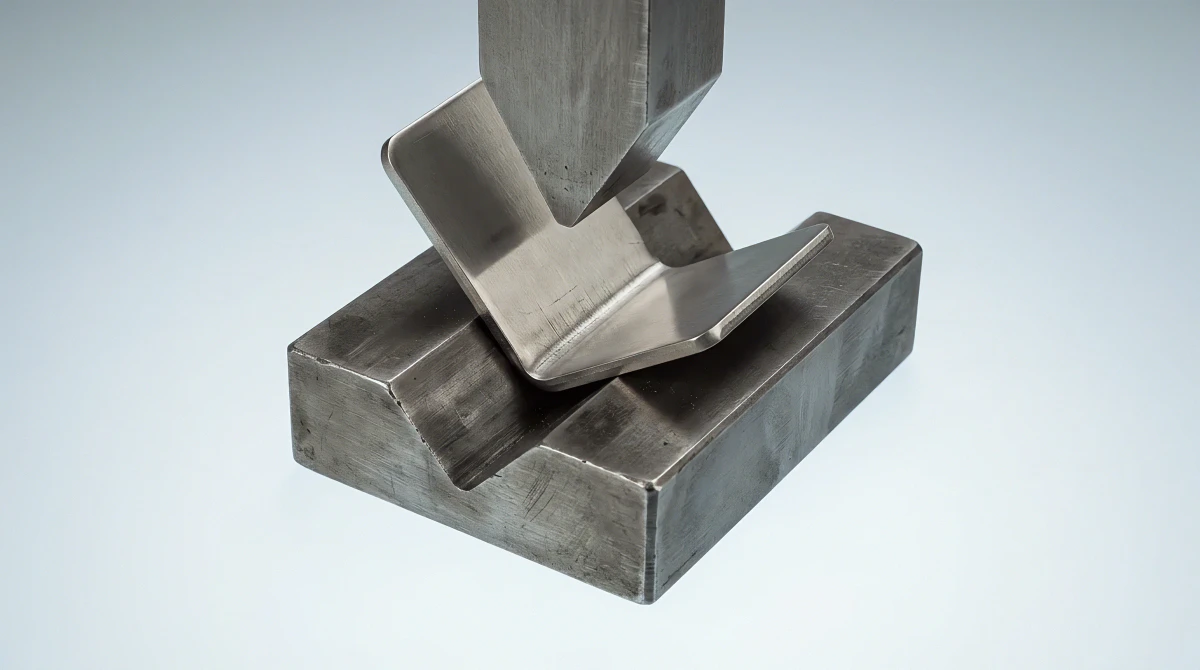
The die opening is the width of the V groove a press brake bends the sheet into, chosen from the thickness and the material. It sets the inside radius, the shortest flange and the bending force. It also changes the flat pattern, so a change after cutting is costly. One thickness sets one die.Rule of Eight
Bystronic’s rule puts the opening at eight times the thickness, rounded to a die the shop owns. For 3.2 mm (0.125 in) plate that is 25.4 mm (1 in). Durma’s chart moves the multiple by material. Stainless takes 10 to 12 thicknesses, 5052 aluminum 5 to 6, and high-strength steel 12 to 20. Wila gives 6 to 8 times for steel up to about 3 mm (0.12 in).Read More
Narrow Limit
A die narrower than five thicknesses harms angular accuracy and risks the machine and tooling, per Bystronic. Wila says an opening under six thicknesses raises force sharply and wears the die flanks. A narrow die also leaves witness marks along the bend.What It Sets
The inside radius comes out at about 16 % of the opening in mild steel. The shortest flange is 0.77 times the opening, by both Bystronic and Durma. Doubling the opening roughly halves the bending force. A wider die gives a larger radius and fewer marks, but more springback once past eight thicknesses.Stainless Note
Euro Inox gives about 5 degrees of overbend for austenitic stainless as a start. Thickness, bend radius and die opening then move that figure. The first formed piece measures the result.