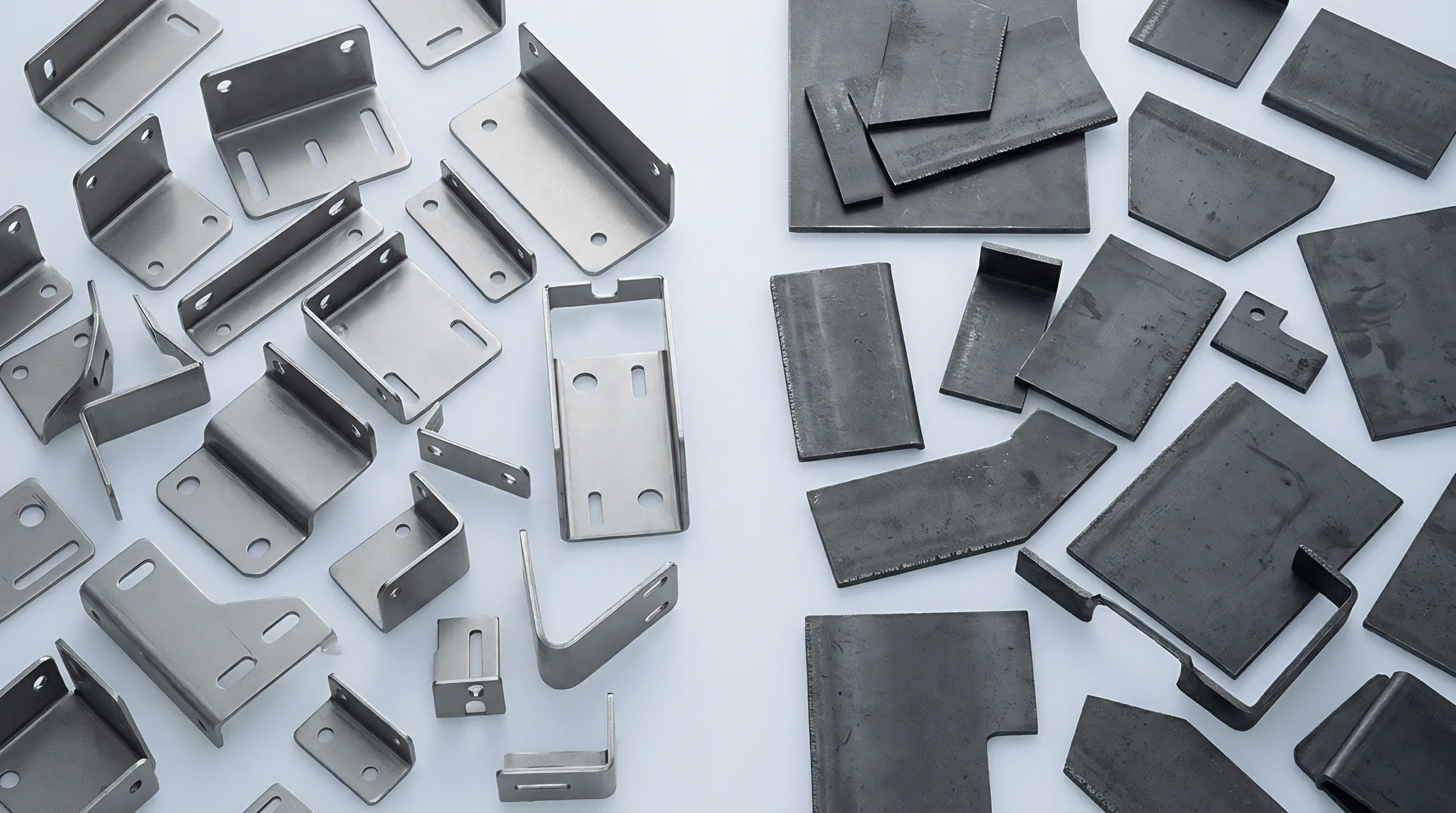
SSAB’s data sheet for its DC01 cold-rolled sheet gives the grade a yield strength of up to 280 MPa (40.6 ksi) and then adds a condition that most drawings never see: the 280 MPa ceiling is valid only for eight days from the time the product is available. After that the steel may age, its yield may rise, and a bracket bent from the same pack a month later can need a different press setting. Hot-rolled S235 carries no such clock in its datasheet, but it brings scale, a wider thickness band and a flatness allowance more than twice as loose.
Those two grades cover a large share of plain steel cut and bent parts, and they overlap at 1.5 to 3 mm (0.059 to 0.118 in), where a buyer can order either. The choice between them is a choice of surface, tolerance, strength and how the sheet will behave at the laser and the brake, and the makers’ own documents set out each of those.
DC01 and S235 Compared for Laser Cut and Bent Sheet Parts
DC01 is a cold-rolled non-alloy mild steel for cold forming under EN 10130, material number 1.0330, which ArcelorMittal describes as having a guaranteed maximum yield and tensile strength, a guaranteed minimum elongation and good formability. S235 is a hot-rolled carbon-manganese structural steel under EN 10025-2, described by the same mill as having a guaranteed minimum yield and tensile strength and satisfactory ductility, in JR, J0 and J2 versions that differ in impact-test temperature.
The wording already shows the difference. DC01 is sold on a ceiling, so that it forms predictably. S235 is sold on a floor, so that a structure carries its load.
| Grade and source | Thickness | Yield strength | Tensile strength | Minimum elongation |
|---|---|---|---|---|
| DC01, EN 10130, transverse, voestalpine | 0.40 to 3.00 mm (0.016 to 0.118 in) | 140 to 280 MPa (20 to 41 ksi) | 270 to 410 MPa (39 to 59 ksi) | A80 28 % |
| DC01, EN 10130, ArcelorMittal | 0.7 to 3 mm (0.028 to 0.118 in) | 140 to 280 MPa (20 to 41 ksi) | 270 to 410 MPa (39 to 59 ksi) | A80 28 % |
| SSAB Form 200, meets and exceeds DC01, transverse | 0.40 to 3.00 mm (0.016 to 0.118 in) | 260 MPa (37.7 ksi) maximum | 280 to 380 MPa (41 to 55 ksi) | A80 29 % |
| S235JR, J0, J2, EN 10025-2, transverse, ArcelorMittal | 1.5 to 2 mm (0.059 to 0.079 in) | 235 MPa (34.1 ksi) minimum | 360 to 510 MPa (52 to 74 ksi) | A80 17 % |
| Same grades | 2.5 to 3 mm (0.098 to 0.118 in) | 235 MPa (34.1 ksi) minimum | 360 to 510 MPa (52 to 74 ksi) | A80 19 % |
| S240 CLAS laser grade, corresponds to S235J0, ArcelorMittal | 2 to 3 mm (0.079 to 0.118 in) | 240 to 320 MPa (35 to 46 ksi) | 360 to 440 MPa (52 to 64 ksi) | A80 22 % |
Two lines of that table deserve a second look. S235’s floor of ultimate tensile strength, 360 MPa (52 ksi), sits in the middle of DC01’s 270 to 410 MPa band, while DC01’s yield can be as low as 140 MPa against S235’s guaranteed 235, so a part redesigned from S235 to DC01 loses strength as well as gaining finish. And the laser-cutting S240 grade shows what a mill can do to S235 when it narrows the band: a yield range of 80 MPa (12 ksi) where the standard sets only a minimum.
DC01 is specified by its upper limits and forms predictably; S235 is specified by its lower limits and carries load. A drawing that swaps one for the other changes both behaviors at once.
Thin Gauge Adjustments
DC01’s figures move at the thin end. SSAB’s DC01 datasheet raises the yield values by 20 MPa (2.9 ksi) for thicknesses over 0.5 and up to 0.7 mm, and by 40 MPa (5.8 ksi) at 0.5 mm and below. Its Form 200 sheet lowers the minimum elongation by 2 points over 0.5 and up to 0.7 mm and by 4 points at 0.5 mm and below. ArcelorMittal prints the same pattern as separate rows: 140 to 320 MPa and 24 % at 0.3 to 0.5 mm, 140 to 300 MPa and 26 % at 0.5 to 0.7 mm.
Thickness Ranges Where DC01 and S235 Overlap
Cold-rolled DC01 stops at 3 mm in every maker datasheet cited here. voestalpine lists 0.40 to 3.00 mm for wide strip, slit strip and cut-to-length sheet, with widths up to 1,615 mm (63.6 in) and cut lengths of 200 to 6,700 mm (7.9 to 264 in). SSAB’s Form 200 runs 0.40 to 3.00 mm in widths up to 1,500 mm (59 in) and lengths up to 8.5 m (28 ft), and ArcelorMittal’s B10 table lists DC01 from 0.40 mm with a minimum width of 600 mm (23.6 in).
Hot-rolled S235 starts where cold-rolled sheet becomes ordinary. ArcelorMittal’s A30 structural steel tables begin at 1.50 mm, with a maximum width of 1,560 mm (61.4 in) for S235JR at 1.50 to 1.60 mm, and run to 20 mm in the mechanical table. Its laser-cutting coils, the CLAS range, start at 2.00 mm.
The overlap, then, is 1.5 to 3 mm. Below it a buyer has only cold-rolled sheet; above it, only hot-rolled. Inside it, the comparison in the next three sections decides.
Cold Rolled Grades With a Structural Floor
The gap between DC01 and S235 is not empty. voestalpine’s cold-rolled range includes S215G to DIN 1623, a structural grade with a minimum yield of 215 MPa (31.2 ksi), a tensile range of 360 to 510 MPa (52 to 74 ksi) and an A80 of 20 %, which gives a cold-rolled surface and tolerance with a tensile range matching S235’s. Alongside it, voestalpine lists micro-alloyed cold-rolled grades under EN 10268, from HC260LA at 260 to 330 MPa (38 to 48 ksi) yield and 26 % elongation up to HC420LA at 420 to 520 MPa (61 to 75 ksi) and 17 %.
Those grades exist for a part that needs strength in a gauge or finish hot-rolled sheet cannot give. They are less common than DC01 and S235 at a service center, so a drawing that calls one usually carries a longer material lead time.
Width and Length Tolerance for the Nest
A nest is laid out on the sheet’s nominal size, and both standards let the sheet come longer, never shorter. In ArcelorMittal’s tables, EN 10131 length tolerance is 0 to +6 mm (0 to +0.24 in) below 2,000 mm (79 in), or 0 to +3 mm on special terms, and 0 to 0.3 % of the length above it. Hot-rolled sheet under EN 10051 is looser: 0 to +10 mm (0 to +0.39 in) below 2,000 mm and up to +40 mm (+1.57 in) at 8,000 mm (315 in) and over.
The practical effect is small but real. A nest that uses the full nominal width loses nothing on either product, while a nest that relies on the actual sheet edge as a datum needs that edge trimmed or measured first, especially on hot-rolled sheet.
Thickness and Flatness Tolerance on Cold Rolled and Hot Rolled Sheet
The two products are rolled to different tolerance standards: EN 10131 for cold-rolled sheet and EN 10051 for hot-rolled. ArcelorMittal’s tolerance tables print both, with the note that the current standard prevails over the printed values.
| Thickness | Cold rolled, EN 10131, Re below 260 MPa, normal | Cold rolled, special | Hot rolled, EN 10051, category A (Re up to 300 MPa) |
|---|---|---|---|
| 1.20 to 1.60 mm (0.047 to 0.063 in) | ±0.08 mm (±0.0031 in) | ±0.050 mm (±0.0020 in) | ±0.17 mm (±0.0067 in), for 2.00 mm and under |
| 1.60 to 2.00 mm (0.063 to 0.079 in) | ±0.10 mm (±0.0039 in) | ±0.060 mm (±0.0024 in) | ±0.17 mm (±0.0067 in) |
| 2.00 to 2.50 mm (0.079 to 0.098 in) | ±0.12 mm (±0.0047 in) | ±0.080 mm (±0.0031 in) | ±0.18 mm (±0.0071 in) |
| 2.50 to 3.00 mm (0.098 to 0.118 in) | ±0.15 mm (±0.0059 in) | ±0.100 mm (±0.0039 in) | ±0.20 mm (±0.0079 in) |
| Flatness, normal, at 1.2 mm and over | 7 mm (0.28 in), width 600 to 1,200 mm | 3 mm (0.12 in), special | 15 mm (0.59 in) per 1,000 mm (39.4 in) at 2.5 to 3 mm; 18 mm (0.71 in) at 2 mm and under |
The hot-rolled thickness band at 2 mm is roughly 1.7 times the cold-rolled one, and roughly three times the cold-rolled special band. Flatness is more than twice as loose, and EN 10051’s special flatness class only narrows it to 11 mm (0.43 in) at 2.5 to 3 mm. Both bands widen with sheet width, and for cold-rolled steel with a yield of 340 MPa (49 ksi) and above, ArcelorMittal states that flatness has to be specified at enquiry and order.
What the Bands Do at the Brake
Thickness variation is a bend-angle variation. A sheet 0.2 mm thicker than nominal sits deeper in the same die, bends to a different angle at the same ram depth and stretches differently, which moves the flange length the flat pattern assumed. Cut from hot-rolled S235 at the edges of its band, a batch therefore shows more angle scatter than one cut from DC01, unless the brake measures and corrects each bend.
Flatness matters earlier, at the laser. A sheet with 15 mm of wave over a meter does not lie on the slats the way the nest assumes, and parts cut from it carry the wave into the bend.
- Close-fitting tabs and slots: EN 10131 normal or special tolerance, which favors DC01 up to 3 mm.
- Structural brackets at 3 mm and over: EN 10051, with a fraction of the standard band ordered where the mill offers it; ArcelorMittal offers three quarters, one half and one third of EN 10051 on its CLAS coils.
- Large flat panels: a flatness class written on the order, since neither standard’s normal class suits a visible panel.
Surface, Scale and Pickling Before Laser Cutting
Cold-rolled sheet arrives bright. ArcelorMittal supplies its cold-forming grades in two surface qualities, A for non-visible parts and B for visible parts, and with a standard roughness of 0.6 to 1.9 µm Ra (24 to 75 µin) unless another range is ordered under EN 10130. voestalpine lists the same A and B normal and best surfaces, and offers the strip oiled.
Hot-rolled sheet arrives with mill scale unless it is pickled. ArcelorMittal’s laser-cutting coil page is direct about why that matters: laser cutting speed depends largely on surface homogeneity and reflectivity. Its mill-finish CLAS coils are offered only in surface A, unexposed. Pickled coils, cleaned in hydrochloric acid, which it describes as giving a cleaner surface for laser cutting than sulfuric acid pickling, are offered in A and B.
Delivery Conditions of S235
ArcelorMittal supplies its structural steels in two delivery conditions. The +AR condition is as-rolled, with no special rolling or heat treatment requirement. Steel delivered +N has been through normalized rolling, with the final pass in a temperature range that gives properties equivalent to normalizing, so they are kept even after a later normalizing treatment. For cut and bent sheet parts the difference rarely matters; for a part that will be heat treated after fabrication it does, and the suffix belongs on the order.
The same page notes that, under the European Construction Products Regulation, products delivered to a harmonized standard such as EN 10025 carry CE marking with a declaration of performance from the maker. A bracket that becomes part of a building is a case where the declaration travels with the mill certificate.
Laser Grades of S235
The same page describes coils made for laser and plasma cutting: low in internal stress, so the sheet stays flat before, during and after cutting when decoiled and leveled properly, and cut significantly faster below 16 mm than standard grades. Its S240 CLAS grade corresponds to S235J0 under EN 10025-2, with the narrow yield band shown in Table 1. A dry protective film, Easyfilm HPE, is offered instead of oil and, the page says, reduces the steel’s reflectivity.
For a buyer, the practical reading is that “S235” and “S235 made for laser cutting” are different purchases from the same standard. The first meets the standard. Only the second also meets the needs of a nest that has to stay flat while the parts are cut out of it.
For a hot-rolled part that is bent rather than loaded, the same page offers S200 CLAS, which combines the drawability of DD12 under EN 10111 with a narrow band of mechanical properties: a yield of 200 to 310 MPa (29 to 45 ksi), a tensile range of 320 to 410 MPa (46 to 59 ksi) and an A80 of 27 % at 2 to 3 mm. Hot-rolled forming steels also roll to a closer thickness band than structural ones. ArcelorMittal’s EN 10051 table for EN 10111 forming steels gives ±0.13 mm (±0.0051 in) at 2 mm and under, against ±0.17 mm for category A.
Surface and internal stress are bought with the sheet. Nothing at the laser restores what the coil did not have.
Aging, Weldability and Galvanizing of DC01 and S235
DC01’s eight-day yield limit is a warning about strain aging, the slow rise in yield strength of some mild steels in storage. SSAB states that for design purposes the lower limit of DC01’s yield may be taken as 140 MPa (20.3 ksi), and that the 280 MPa upper limit holds only for eight days from availability. A part whose bend angle depends on a soft sheet is better bent from fresh material, and a pack held for months is worth a test bend before a batch.
The forming grades above DC01 carry figures DC01 lacks. voestalpine prints minimum r values (plastic strain ratio) from 1.3 for DC03 to 2.5 for DC07 and minimum n values (strain hardening) for DC04 and above, while DC01’s columns are empty. DC01 is the basic grade of the family; deep or difficult forming moves up to DC03 or DC04.
Storage and Surface Care
Mild cold-rolled sheet is easy to spoil in the store. SSAB’s DC01 datasheet states that its surface treatments give only temporary protection during transport and storage, that the product has to be kept dry, and that wet sheets are separated and dried quickly to avoid corrosion damage. ArcelorMittal adds, for its cold-forming range, that a cleaner surface is available through hydrogen annealing in its DCxxxCS versions, and that the low scatter of its chemistry and mechanical properties is what gives consistent processing. Forming limit curves for its grades are available on request.
Rust on a stored pack of DC01 shows up later as poor paint adhesion along the cut edges and on the faces. Taken together with the aging limit, it argues for buying DC01 close to the date it is cut.
Chemistry and Welding
The chemistries are lean for both. SSAB’s DC01 datasheet caps carbon at 0.12 %, manganese at 0.60 % and phosphorus and sulfur at 0.045 % each, and its Form 200 version caps carbon at 0.10 %. ArcelorMittal caps S235 at 0.17 % carbon, 1.40 % manganese and a carbon equivalent of 0.35 %, with phosphorus and sulfur falling from 0.035 % for JR to 0.025 % for J2.
On welding, ArcelorMittal says weldability of its cold-forming grades is guaranteed with the usual processes and asks that the intended process be named on the order. For its structural steels it states that pre- or post-heat treatment is not necessary in most cases with conventional processes.
Hot-Dip Galvanizing After Fabrication
Galvanizing a fabricated part brings in silicon and phosphorus, which control how the zinc grows. ArcelorMittal’s A30 page lists suitability for galvanizing as an option to be agreed, designated +CL1 or +CL3, and marks which of its own S235 products carry Class 1. Its standard EN 10025-2 rows say “No”. A part that will be galvanized after cutting and welding therefore needs the option written on the order, since the standard grade alone does not promise it.
- Impact class: S235JR is tested at 20 °C (68 °F), J0 at 0 °C (32 °F) and J2 at −20 °C (−4 °F), each to 27 J on longitudinal specimens 6 to 20 mm thick; thinner sheet is not impact tested in ArcelorMittal’s table.
- Cold forming option: ArcelorMittal lists suitability for cold forming as option +C, to be agreed.
- Copper addition: option +Cu, also by agreement.
Writing DC01 or S235 on a Drawing
Grade names travel well; old names do not. ArcelorMittal’s correspondence table equates DC01 to material number 1.0330, to JIS G3141 SPCC and to ASTM A366 CQ. For S235JR it lists the former DIN 17100 name RSt37-2, ASTM A1011 SS Grade 36 and JIS G3101 SS330. A drawing that carries St37 or SPCC is naming a grade family, and the material line on the order is where it becomes a standard and a grade.
| Item | DC01 | S235 |
|---|---|---|
| Standard and grade | EN 10130 DC01 | EN 10025-2 S235JR, J0 or J2 |
| Thickness tolerance | EN 10131, normal or special | EN 10051, or a fraction of it where offered |
| Flatness | EN 10131 class, written for panels | EN 10051 class, or flat sheet from a laser grade |
| Surface | A or B, roughness range if visible | mill finish or pickled |
| Coating after fabrication | named, with the process | +CL1 or +CL3 if galvanized |
The table is a checklist, not a recommendation of either grade. DC01 suits thin, formed, painted parts where flatness and finish matter. S235 suits thicker parts that carry load and may be welded and galvanized. In the overlap from 1.5 to 3 mm, tolerance and surface usually decide.
A first run of brackets or covers in DC01 or S235 fits low-volume sheet metal, where the actual thickness and flatness of the delivered sheet are measured once, and the order line that comes out of that run is the one a later bridge production batch repeats.
Whether a pack of DC01 aged past its eight days still bends to the first batch’s angle is a question no datasheet answers, and the first piece of each delivery is the place it gets checked.
Sources and Further Reading
- Cold-Rolled Steel Strip, Range of Supply, November 2024, voestalpine Steel Division
- SSAB Form 200 Cold-Rolled, SSAB
- SSAB DC01 Zero, SSAB
- B10, Steels for Cold Forming, ArcelorMittal Europe, Flat Products
- A30, Structural Steels, ArcelorMittal Europe, Flat Products
- A40, Steel Coils for Laser Cutting Applications, ArcelorMittal Europe, Flat Products
- Tolerance and Conversion Tables, ArcelorMittal Europe, Flat Products