Meaning
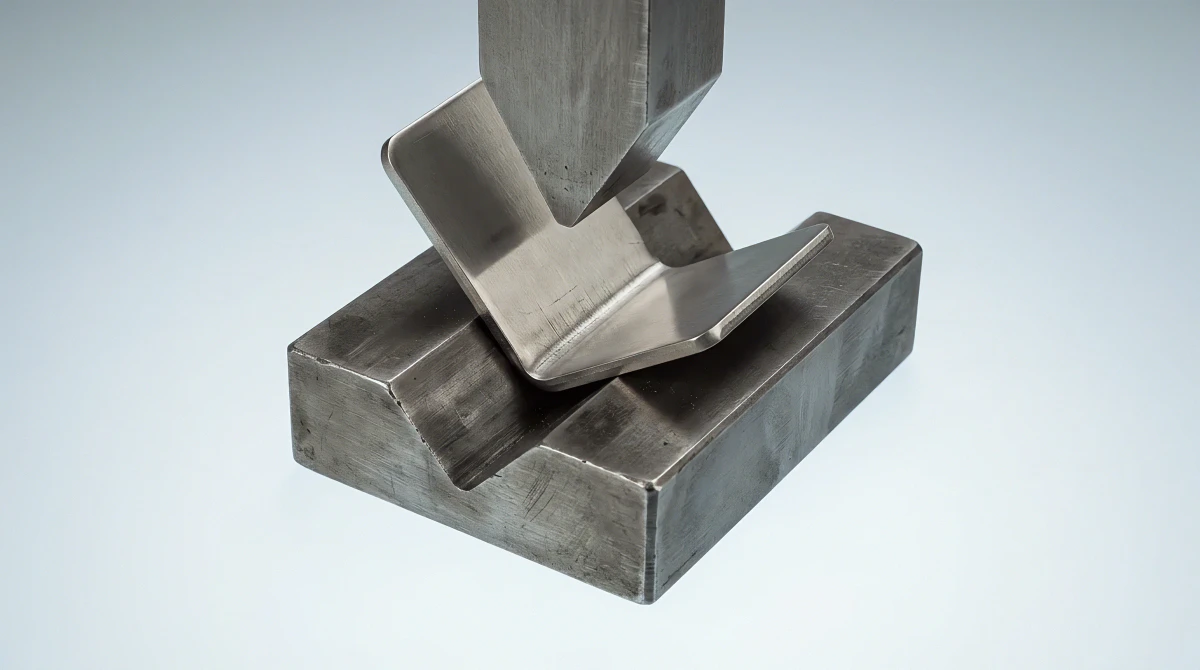
Overbend is bending a sheet past its final angle so that, after springback, it settles at the angle on the drawing. Every metal springs back by its elastic share of the bend. The overbend needed rises with yield strength and with the ratio of inside radius to thickness.Typical Values
SSAB’s calculated springback for its Domex 355MC on a 90 degree bend is 3.9 degrees at 5, 10 and 15 mm, and its Strenx 700MC about 6.7 to 6.9 degrees, while its wear plates exceed 15 degrees. SSAB states that high-strength steel cannot be bent to 90 degrees in a 90 degree die, so the die has to leave room to go past. The Fabricator notes springback of as much as 60 degrees on high-strength steel bent to large radii.Read More
Tooling
In air bending, the die angle exists mainly to let the punch descend far enough to overbend. Bottoming and coining reduce or remove springback by force instead; The Fabricator warns that coining does so at the expense of the material’s integrity and possibly the press brake. On the drawing side, a part that keeps the same grade, thickness and rolling direction for every bend lets one overbend correction serve all of them.From Lot to Lot
Yield strength differs between lots of one grade, so the overbend that was right for one material lot can be wrong for the next. Durmapress lists that drift among the commonest causes of angle problems, and angle measurement with automatic correction is the machine feature that answers it. The first piece of each lot is where the setting is confirmed.