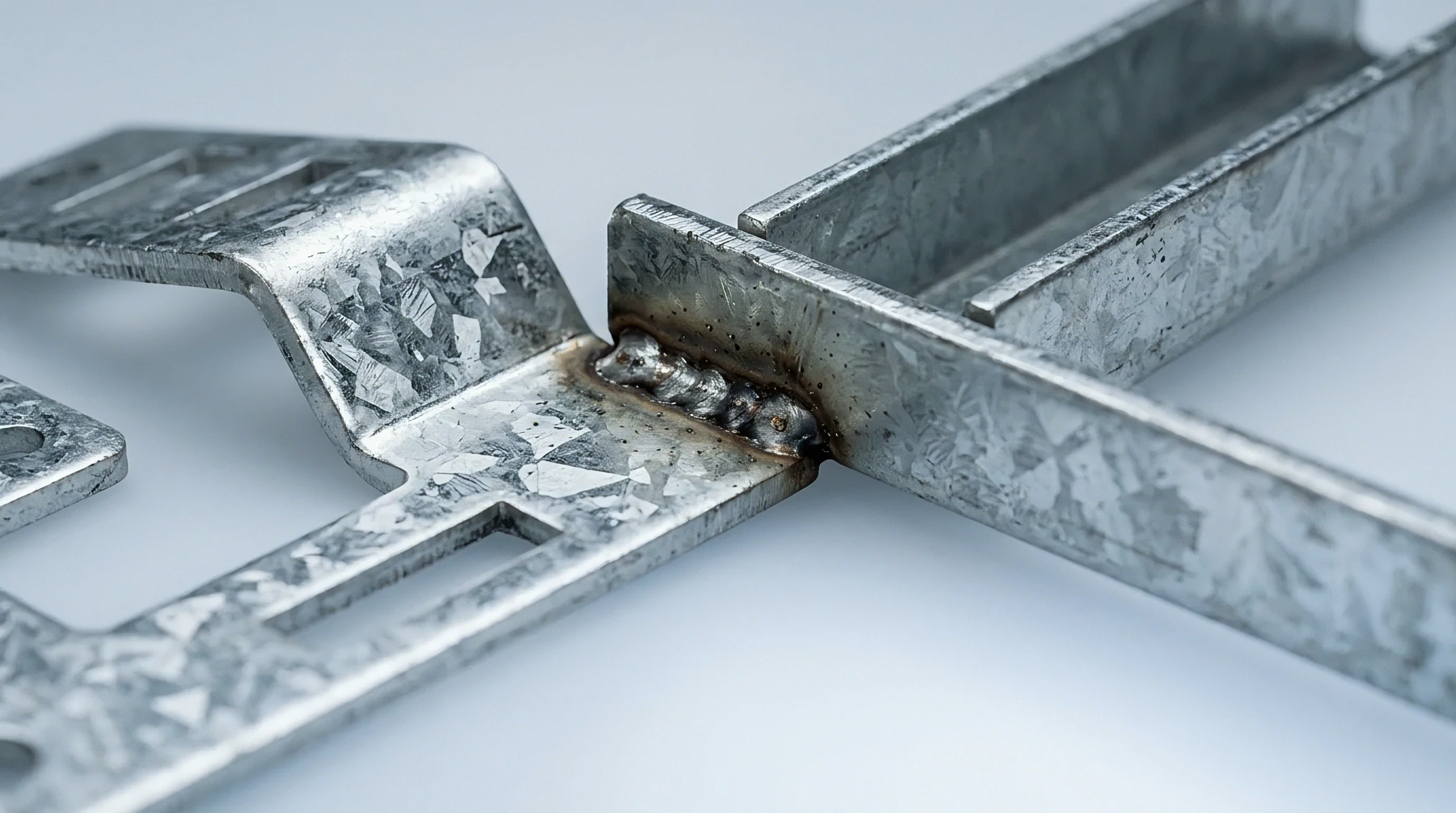
A G90 coating adds about 42 µm to a steel sheet, split across two faces, and nobody checks it with a micrometer. The GalvInfo Center explains why: to find the zinc layer by thickness, you would measure the coated sheet, strip the coating off, measure the bare steel to a ten-thousandth of an inch and subtract, which is hard to do accurately and harder to repeat. Instead, the referee method is to weigh a coupon, strip the zinc in inhibited acid, and weigh it again.
That is why galvanized sheet is bought by mass and not by thickness, and why its designations (G90, Z275, ZF120, 13Z13Z) read like part numbers. A buyer of cut and welded parts meets them on the mill certificate, on the drawing’s material line and in the quote.
What a Coating Weight Designation Says About the Sheet
A designation states the minimum mass of zinc, or zinc alloy, on the sheet and the units it is stated in. G90 means hot-dip galvanized, with a triple spot test average of at least 0.90 ounce per square foot, counted over both sides together. If the coating were split evenly, each face would carry 0.45 ounce per square foot. In metric terms the same coating is Z275: 275 g/m², both sides.
The number is a mass per area, and thickness follows from it. GalvInfo gives the conversion for galvanized and galvannealed sheet, based on a zinc density of 7,140 kg/m³ (446 lb/ft³): 1.00 oz/ft² equals 305 g/m², 0.0427 mm (0.00168 in). The note’s own G90 example is about 1.6 mils, or 42 µm, in total and about 0.0008 in, or 21 µm, on each face. Applied to 0.90 oz/ft², the conversion factor gives 38 µm, so the note’s figure is a rounded one, and the safe reading is “about 40 µm in total.”
A designation such as G90 or Z275 is a minimum mass of zinc per area, counted over both faces. The thickness is derived from it, never measured directly on the sheet.
G and Z Designations for Hot Dip Galvanized Sheet
The common hot-dip designations come in two systems. GalvInfo lists G30, G40, G60, G90 and G115 in ounces per square foot, and the SI set Z90, Z120, Z180, Z275 and Z350 in grams per square meter. Heavier coatings, G165 and G210, exist for specialized uses and are generally not available on thin sheet.
Old names still circulate beside the new ones. GalvInfo traces G90 back to “1.25 Commercial,” a trade class standardized in ASTM A525 in 1964, with “Light Commercial” becoming G60 and the heavy “2.50” class becoming G210. The note points out that 1.25 Commercial has not existed since the late 1950s and is still occasionally quoted, and that gauge numbers were never regulated and stand for a range of thicknesses. A quote that says “16 gauge, 1.25 Commercial” names neither a thickness nor a coating in today’s terms.
The two sets line up by the 305 g/m² factor. Table 1 pairs them and adds the total coating thickness that the 0.0427 mm per ounce relation implies.
| Inch-pound designation | SI designation | Minimum triple spot average, both sides | Derived total zinc thickness |
|---|---|---|---|
| G30 | Z90 | 0.30 oz/ft² (about 90 g/m²) | about 13 µm (0.0005 in) |
| G40 | Z120 | 0.40 oz/ft² (about 120 g/m²) | about 17 µm (0.0007 in) |
| G60 | Z180 | 0.60 oz/ft² (about 180 g/m²) | about 26 µm (0.0010 in) |
| G90 | Z275 | 0.90 oz/ft² (275 g/m²) | about 38 µm (0.0015 in) |
| G115 | Z350 | 1.15 oz/ft² (about 350 g/m²) | about 49 µm (0.0019 in) |
Only the G90 and Z275 pairing is stated outright in the note. The other pairs follow from the 305 factor, which matches the order in which the note lists the two sets.
Coating weight sets corrosion life in a simple way for galvanized sheet. The note says life in a given environment is approximately a linear function of coating weight, defined as the time to 5 % red rust. A G60 coating is twice the thickness of G30 and lasts about twice as long, and G90 is about 50 % thicker than G60 and performs about 50 % better. The note adds that limits on the heaviest coating usually come from other factors, formability among them.
Triple Spot and Single Spot Tests, and What They Check on a Cut Part
The designation is verified by two tests. The triple spot test (TST) averages three readings taken edge, center, edge across the original full-width sheet as coated. Beside it, the single spot test (SST) sets a floor for any one reading. For G90, ASTM A653 asks for a TST average of at least 0.90 oz/ft², a single spot value of at least 0.80 oz/ft² both sides, and normally no less than 40 % of that single spot minimum, or 0.32 oz/ft², on any one face.
GalvInfo works through four G90 examples, and Table 2 reproduces their logic.
| Example | Edge 1 | Center | Edge 2 | Triple spot average | Result |
|---|---|---|---|---|---|
| 1 | 0.92 | 0.93 | 0.96 | 0.94 | passes |
| 2 | 0.85 | 0.93 | 0.96 | 0.91 | passes |
| 3 | 0.85 | 0.87 | 0.96 | 0.89 | fails the 0.90 triple spot minimum |
| 4 | 0.78 | 0.95 | 0.96 | 0.90 | fails the 0.80 single spot minimum |
Example 4 is the instructive one. Its average meets 0.90, and the sheet still fails because one edge reading dropped below the single spot floor. A coil can pass on the mean and fail on the edge.
For a buyer of cut parts, the note carries one more rule. The triple spot test applies only to the original full-width sheet. Narrow sheet cut from full-width sheet is subject only to the minimum single spot requirement for total both sides. A blank nested out of a cut sheet therefore has a single spot guarantee and no triple spot guarantee, and the mill’s test belongs to the parent coil.
- The certificate reports the coil’s test, not each blank.
- A part cut from a wide sheet is protected by the single spot floor and not by the triple spot average.
- A coating mass requirement on a part drawing needs a stated test location to mean anything.
The single spot floors scale with the designation in the same way. In SI units Z275 carries a triple spot minimum of 275 g/m² and a single spot minimum of 235 g/m², both for the total on the two faces, while the galvannealed ZF120 carries 120 g/m² and 90 g/m². For inch-pound units, galvannealed A40 needs 0.40 oz/ft² on the triple spot test and 0.30 oz/ft² on the single spot test. GalvInfo adds that the iron in galvannealed coatings makes the coating slightly denser, and slightly thinner than the equivalent galvanized coating for A40 against G40, and that the difference is too small to matter.
How Much Zinc Sits on a Sheet and Against the Thickness Tolerance
The mass figures become concrete on a standard stock sheet. A 2,500 x 1,250 mm sheet has 3.125 m² of area, so Z275 at its 275 g/m² minimum puts at least 860 g of zinc on it, and Z90 puts at least 280 g. The heavier coating carries just over three times the zinc, in line with the 305 factor that links 0.30 oz/ft² to 0.90 oz/ft².
Against the steel, the layer is thin. A total of about 40 µm on a 1.5 mm sheet is under 3 % of the thickness, and on 3 mm it is under 1.5 %. The layer still competes with the tolerance on the sheet.
ArcelorMittal’s tolerance tables for hot-dip coated flat products to EN 10143 list a normal thickness tolerance of 0.07 mm either way for 1.00 to 1.20 mm sheet up to 1,200 mm wide (steel with a yield strength under 260 MPa), and 0.050 mm for the special tolerance. A coating of 38 µm in total is more than half of that normal band, and it is about three quarters of the special band.
The extract does not say whether the EN 10143 tolerance is applied to the coated or the bare thickness, and the standard itself decides that. A part whose joint depends on a stack of sheet thicknesses, such as a slot and tab fit, should state which thickness the drawing means and ask the mill or the stockist to confirm the basis. The design question is whether the nominal thickness on the drawing is the bare steel or the finished sheet, since a tab joint cut to the bare value will meet a coated sheet that is up to the coating thickness thicker.
Galvannealed and Electrogalvanized Designations That Look Alike
Other zinc coatings use other prefixes, and they are easy to confuse with the G and Z of hot-dip sheet. Galvannealed sheet, a zinc-iron coating with about 8 to 10 % iron, uses A25, A40 and A60 in inch-pound units and ZF75, ZF120 and ZF180 in SI. A40 requires a triple spot average of at least 0.40 oz/ft² both sides, and ZF120 requires 120 g/m².
Single-side designations behave differently from all of these. Since 2007, ASTM A653/A653M has allowed SI designations that give a minimum and a maximum per face for any single spot, such as 60G, which means 60 g/m² minimum and 110 g/m² maximum on each surface. Both faces are written out, as in 60G60G. Galvannealed sheet has the same pattern in 45A45A, with 45 g/m² minimum and 75 g/m² maximum on each face.
Electrogalvanized sheet to ASTM A879 uses single-side limits as well, and here the letters flip. For hot-dip, G before the numerals means ounces and Z means grams per square meter. Electrogalvanized sheet reverses it: G after the numerals means grams and Z means ounces. The note calls the reversal a standing source of confusion among buyers and sellers.
- 13Z13Z means 0.13 oz/ft² minimum and 0.23 oz/ft² maximum on each face, in inch-pound units.
- 40G40G means 40 g/m² minimum per face, in SI units.
- GalvInfo prints the maximum for 40G as 90 g/m² in one place and 70 g/m² in a summary table, so the limit is read from ASTM A879M and not from either figure.
Read the letters and their position. G30 and 30G are different products, and a drawing that does not say which standard it means can ship the wrong one.
Zinc Fume From Cutting and Welding Coated Sheet
Zinc is the reason galvanized sheet needs a different shop setup. The American Welding Society’s Fact Sheet 25 names zinc oxide fume from welding, cutting or brazing galvanized steel as the most common cause of metal fume fever, a flu-like illness with headache, fever, chills, muscle aches, nausea and fatigue. Symptoms usually begin several hours after exposure, the attack lasts 6 to 24 hours and recovery generally takes 24 to 48 hours. It is more likely after a period away from the job, such as a weekend.
The fact sheet quotes the OSHA permissible exposure limit of 5 mg/m³ of zinc oxide fume averaged over eight hours, and a NIOSH recommended short-term limit of 10 mg/m³ over 15 minutes. It points to local exhaust at the arc as the first control, general ventilation next, and an approved respirator when neither is adequate. The sheet does not state a fume rate per coating weight, so no figure here ties G90 to a fume level.
For the weld itself, ISO 5817 treats spatter as a condition whose acceptance depends on the application, for example material and corrosion protection, at every quality level. Its introduction adds that welds to be coated later may need more thorough post-weld treatment or surface finishing. On galvanized sheet, spatter and burned-off zinc beside the seam are exactly the conditions that sentence is about, and the drawing has to say what is acceptable.
Painting Galvanized Sheet and Pairing It With Stainless Hardware
Powder coating over zinc starts with pre-treatment. The IGP Powder Coatings data sheet for a matte powder lists zinc phosphating, chrome (III) passivation or chromating to DIN EN 12487 for galvanized steel. For aluminum and galvanized parts it sets a minimum test of a boiling water test followed by a cross-cut adhesion and tape test.
The recommended film is 60 to 80 µm (0.0024 to 0.0031 in), and the sheet leaves the choice of pre-treatment to the coater’s own trials. That data sheet lists the powder’s characteristics as matte, smooth and indoor quality, which is a reminder that a coating system is chosen for its service environment as well as for its adhesion. A galvanized part headed outdoors needs a powder and a pre-treatment that its maker rates for outdoor use, and that rating lives on the powder’s own data sheet, not on the zinc designation.
Fasteners bring a second concern. Euro Inox notes that stainless steel is more noble than galvanized or uncoated carbon steel, zinc and aluminum, and that unless the metals are electrically separated, moisture will corrode the less noble one. A stainless screw in a galvanized panel is the textbook case. The guide recommends a non-metallic barrier such as neoprene or nylon, and it adds that a large stainless area against a small less noble fixing speeds the attack on the fixing.
What to Write on the Order for Galvanized Sheet
A certificate that reads Z275 to ASTM A653M and one that reads G90 to ASTM A653 describe the same minimum, 275 g/m² or 0.90 oz/ft² both sides, so the system of units is not a reason to refuse either. A mismatch of prefix and standard is the reason: an A879 designation with a G after the numerals is a single-side electrogalvanized limit, not a hot-dip minimum. Reading the letters, the unit and the standard together takes a minute and closes the largest ordering gap in the family.
The designation, the standard and the test location belong on the order together. Table 3 lists the lines to fill in.
| Line | Example | Why it is needed |
|---|---|---|
| Coating type | hot-dip galvanized, galvannealed or electrogalvanized | the prefixes G, ZF, A and Z mean different coatings |
| Designation | Z275 or G90 | the minimum mass of zinc, both sides |
| Standard | ASTM A653 or A653M, or A879 for electrogalvanized | the standard sets the tests and the single-side rules |
| Test basis | triple spot on the parent coil; single spot on cut blanks | the triple spot test covers only the full-width sheet |
| Weld note | spatter and zinc burn acceptance, ISO 5817 level named | the standard leaves spatter to the application |
| Coating note | pre-treatment type and adhesion test | the IGP data sheet leaves the choice to the coater |
A cut and welded galvanized part is a small chemistry problem wrapped around a steel part, and the order is the place to say so. A short first run in the material suits low-volume sheet metal, and a part that settles into regular repeat orders is ready for bridge production with the designation and test basis already fixed.
Sources and Further Reading
- GalvInfo Center, GalvInfoNote 1.1, Understanding Coating Weight Designations for Zinc-Based Coatings on Steel Sheet, Rev 4.0, December 2020
- American Welding Society, Safety and Health Fact Sheet No. 25, Metal Fume Fever, January 2002
- ISO, ISO 5817:2023, Welding, Fusion-welded joints in steel, nickel, titanium and their alloys, Quality levels for imperfections (copy hosted by SSAB)
- IGP Powder Coatings, Technical data sheet IGP-DURA mix 3303E-A1, version 1.2, 24 April 2024
- Euro Inox, Guide to Stainless Steel Finishes, Building Series Volume 1, third edition 2005