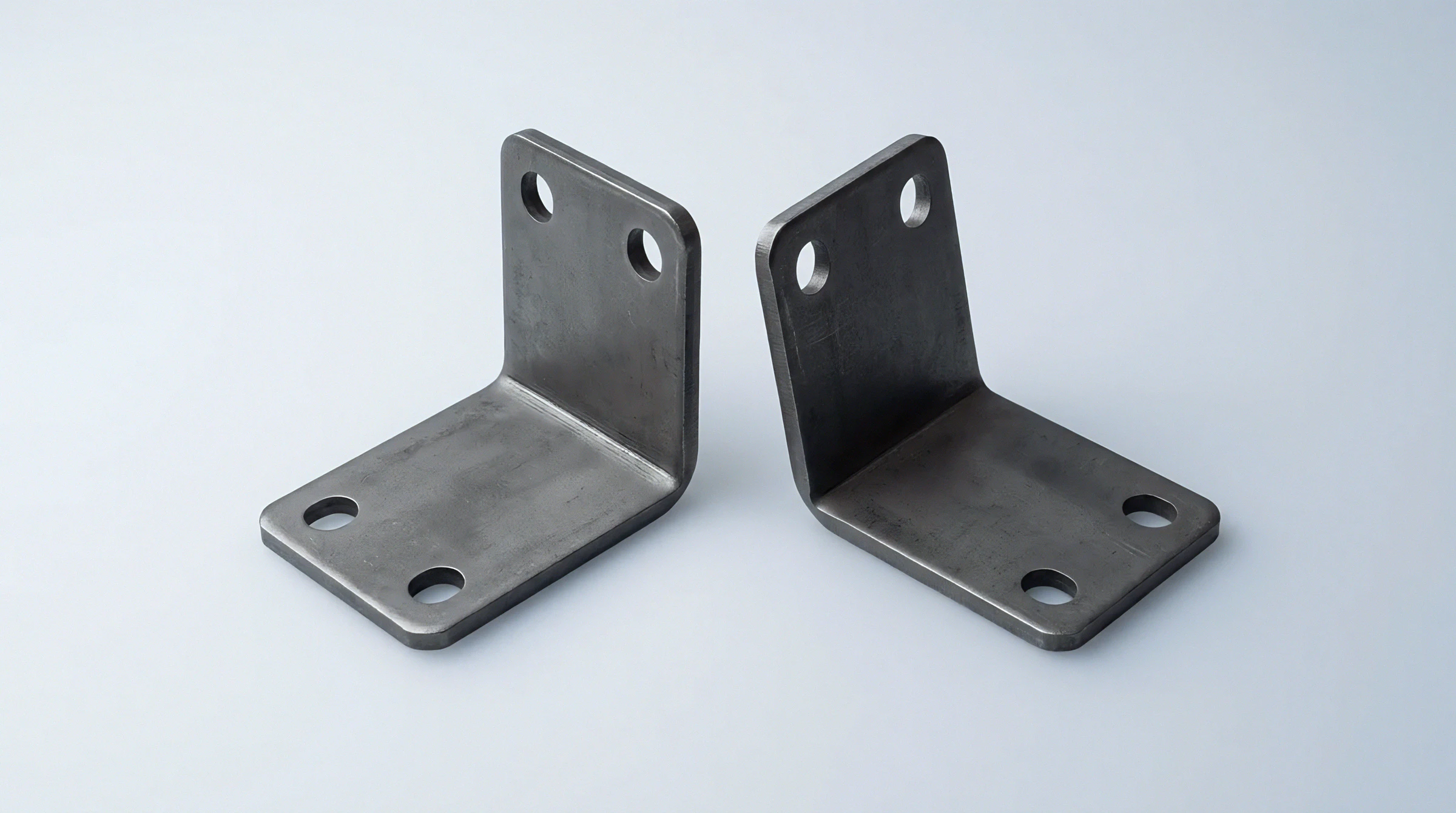
Two steels can both be called S355 and bend nothing alike. In ArcelorMittal’s catalogue, S355J2 hot-rolled sheet under EN 10025-2 at 1.5 to 2 mm thick carries a tensile range of 510 to 680 MPa (74 to 99 ksi) and a minimum elongation of 14 %. S355MC under EN 10149-2, at the same thickness and the same minimum yield of 355 MPa (51.5 ksi), carries 430 to 550 MPa (62 to 80 ksi) and 19 %. A drawing that says only “S355” has left the supplier to choose between a structural steel and a cold-forming steel, and the press brake will notice which one arrived.
That gap is the first thing to settle when a bent part moves up from mild steel. The second is springback. SSAB’s own calculation for its Domex 355MC puts springback at 3.9 degrees on a 90 degree bend at 5, 10 and 15 mm, and its harder grades run to 14 to 19 degrees. Grade, radius and overbend come together, and the sections below take them in that order.
S355 and S420 Sheet Grades in EN 10149-2 and EN 10025-2
High-strength sheet for cut and bent parts comes mainly from two European product standards. EN 10025-2 covers non-alloy structural steels, the S235, S275 and S355 families with the JR, J0 and J2 suffixes that set the impact-test temperature. Its companion for forming, EN 10149-2, covers thermomechanically rolled steels for cold forming, the MC grades from S315MC to S700MC, which Salzgitter describes as low-pearlite steels with good bending, flanging and folding properties in both the longitudinal and transverse directions.
In the maker datasheets cited here, S420 sheet appears only as S420MC. The datasheets (SSAB Domex 420MC, ArcelorMittal Amstrong 420MC, thyssenkrupp precidur HSM 420, Salzgitter’s S420MC) all refer to EN 10149-2, and none of them prints a structural S420 sheet grade for this thickness range.
| Grade and standard | Source | Minimum yield | Tensile strength | Minimum elongation, A80 |
|---|---|---|---|---|
| S355J2, EN 10025-2, 1.5 to 2 mm, transverse | ArcelorMittal A30 | 355 MPa (51.5 ksi) | 510 to 680 MPa (74 to 99 ksi) | 14 % |
| S355MC, EN 10149-2, 1.5 to 3 mm, longitudinal | ArcelorMittal A20 | 355 MPa (51.5 ksi) | 430 to 550 MPa (62 to 80 ksi) | 19 % |
| SSAB Domex 355MC, 1.8 to 3 mm, longitudinal | SSAB | 355 MPa (51.5 ksi) | 430 to 550 MPa (62 to 80 ksi) | 19 % |
| precidur HSM 355, rolling direction | thyssenkrupp | 355 MPa (51.5 ksi) | 430 to 510 MPa (62 to 74 ksi) | 21 % |
| S420MC, EN 10149-2, 1.5 to 3 mm, longitudinal | ArcelorMittal A20 | 420 MPa (60.9 ksi) | 480 to 620 MPa (70 to 90 ksi) | 16 % |
| SSAB Domex 420MC, 1.8 to 3 mm, longitudinal | SSAB | 420 MPa (60.9 ksi) | 480 to 620 MPa (70 to 90 ksi) | 16 % |
| Amstrong 420MC, below 3 mm, longitudinal | ArcelorMittal A20 | 420 to 520 MPa (61 to 75 ksi) | 490 to 600 MPa (71 to 87 ksi) | 18 % |
| precidur HSM 420, rolling direction | thyssenkrupp | 420 MPa (60.9 ksi) | 480 to 580 MPa (70 to 84 ksi) | 18 % |
Standard rows and maker rows differ in a way that matters at the brake. EN 10149-2 sets a minimum yield and a tensile band; several makers deliver inside a narrower one. ArcelorMittal marks its Amstrong values in bold where they are tighter than the standard, and gives an upper yield limit for Amstrong 420MC of 520 MPa (75 ksi).
A yield ceiling is what keeps springback from wandering, because two coils at 425 and 515 MPa are both legal S420MC and will not bend to the same angle at the same ram depth.
Same minimum yield, different steel. S355J2 is ordered for structures and S355MC for bending, and the standard number on the order is what tells them apart.
Names on Older Drawings
Material numbers agree across makers: Salzgitter and thyssenkrupp both give 1.0976 for S355MC and 1.0980 for S420MC. Old names do not.
ArcelorMittal’s correspondence table maps S355MC to the former German QStE 380 TM and S420MC to QStE 460 TM, while Salzgitter lists QStE 380 TM as a grade of its own, number 1.0978, and gives QStE 420 TM for S420MC. ArcelorMittal also names ASTM A1011 HSLAS-F Grade 50 and Grade 60 as the closest US grades. Any drawing that carries an old QStE name or a US grade is therefore a drawing whose steel is confirmed by material number before anything is cut.
Tensile Strength Bands and Press Force
Yield sets where bending begins; ultimate tensile strength sets how hard the sheet resists once it is bending. Both rise from S355 to S420, and both feed the force a press brake has to deliver and the angle the sheet returns to. SSAB’s springback page gives BendCalc press forces for 90 degree bends: its Domex 355MC needs 310 kN per meter of bend at 5 mm, 630 kN/m at 10 mm and 950 kN/m at 15 mm (10.6, 21.6 and 32.5 US tons per foot), against 570 and 1,170 kN/m for its Strenx 700MC at 5 and 10 mm.
Why the Band Width Matters More Than the Minimum
A buyer reads the minimum yield. The brake works on the actual one.
In Table 1, standard S355MC allows tensile strength anywhere across a 120 MPa (17 ksi) band, and S355J2 below 3 mm across 170 MPa (25 ksi). Two sheets from opposite ends of the band need different ram depths for the same angle, and a batch cut from mixed coils shows that as angle scatter. Narrow-band products such as precidur HSM 355, with 80 MPa (12 ksi) of tensile range, are one answer; keeping a batch to one heat or coil is the other.
Thickness adds its own limits. Salzgitter notes that above 8 mm the yield values of its MC grades may be reduced by 20 MPa (2.9 ksi), so thick parts do not carry the thin-sheet minimum. SSAB’s tensile tests on Domex are longitudinal while its bend radii apply in both directions, and ArcelorMittal tests its EN 10025-2 grades transversely. A mill certificate is read against the direction its standard names.
- Minimum yield decides whether the part meets its design load and is the figure the grade name carries.
- Upper yield or tensile band decides how much the bend angle drifts from coil to coil, and only some makers print one.
- Elongation gives a first idea of how tight a radius the sheet tolerates; it falls from 19 % to 16 % between S355MC and S420MC at thin gauge.
Springback Angles for S355MC and Harder Grades
Springback is the elastic part of the bend coming back once the punch lifts. SSAB states that it grows with the steel’s strength and with the die width measured in plate thicknesses, and that high-strength steel cannot be bent to 90 degrees in a 90 degree die: the die has to allow overbending beyond the final angle. Its table, calculated with its BendCalc program for 90 degree bends made longitudinal to the rolling direction under its own recommendations, puts numbers on that.
| Grade | Thickness | Press force | Springback |
|---|---|---|---|
| SSAB Domex 355MC | 5 mm (0.20 in) | 310 kN/m | 3.9° |
| SSAB Domex 355MC | 10 mm (0.39 in) | 630 kN/m | 3.9° |
| SSAB Domex 355MC | 15 mm (0.59 in) | 950 kN/m | 3.9° |
| Strenx 700MC | 5 mm (0.20 in) | 570 kN/m | 6.7° |
| Strenx 700MC | 10 mm (0.39 in) | 1,170 kN/m | 6.9° |
| Strenx 1100E | 5 mm (0.20 in) | 820 kN/m | 14.2° |
| Hardox 450 | 10 mm (0.39 in) | 1,380 kN/m | 16.6° |
| Hardox 500 Tuf | 10 mm (0.39 in) | 1,570 kN/m | 19.0° |
Two things stand out. The 355MC figure does not move with thickness under SSAB’s bending recommendations. And springback climbs steeply with strength: from S355 to a 700 MPa grade it rises by roughly three degrees, and wear plate takes it past fifteen. S420MC is not in SSAB’s table, and no maker cited here prints a springback figure for it; between the 355MC and 700MC rows is where its behavior lies, and the first test bend is where it gets measured.
The Variables Behind One Angle
An article on springback in The Fabricator lists what a calculation needs: the modulus of elasticity, the yield strength, the K-factor, the inside bend radius, the material thickness and the included bend angle. Its equation takes the ratio of inside radius times yield strength to modulus times thickness as its starting term. For a buyer the useful reading is directional. Higher yield, a larger radius relative to thickness and a lower modulus all mean more springback.
The same article warns that high-strength steels bent to large radii can spring back by as much as 60 degrees, and that heavy overbending of a large radius can leave a smaller radius under the punch, which it calls multibreakage. Air bending a high-strength sheet over a wide die therefore gives a larger radius and more springback at once.
Springback grows with yield strength and with the radius-to-thickness ratio. A part that moves from DC01 to S420MC without a change of die or angle program will come off the brake open.
Bottoming and Coining Against Springback
Air bending is not the only way to deal with springback. The Fabricator’s article notes that bottoming forces the workpiece to the die angle, with the punch radius pressed into the material until the bend opens up to conform, and that coining applies enough force to remove springback entirely. It also warns that coining does so at the expense of the material’s integrity and possibly the press brake. For S355MC and S420MC, whose press forces in Table 2 are already large at moderate thickness, air bending with a measured overbend is the usual answer.
Overbending in Practice
Overbend is set at the machine, but the drawing decides how hard it is to find. A part that holds the same grade, thickness and rolling direction for every bend lets one correction serve all of them. SSAB’s note on longitudinal bending is a reminder that the direction of the bend relative to rolling is part of the condition, and The Fabricator’s bending articles add that bending with the grain needs a larger radius than bending across it.
Minimum Inside Bend Radius for S355MC and S420MC
The minimum radius is a maker’s figure for bending without cracks, and the makers print it differently. Salzgitter gives the smallest recommended radius for bend angles up to 90 degrees, SSAB the minimum inner radius for a 90 degree bend in both directions, and ArcelorMittal the minimum mandrel diameter for a 180 degree bend under EN 10149-2. The three are not the same test, so they are compared with care.
| Grade and source | Up to 3 mm (0.118 in) | Over 3 to 6 mm (0.118 to 0.236 in) | Over 6 mm (0.236 in) |
|---|---|---|---|
| S355MC, Salzgitter, bends up to 90° | 0.25 t | 0.5 t | 1.0 t |
| SSAB Domex 355MC, 90° bend | 0.2 t | 0.3 t | 0.5 t |
| S420MC, Salzgitter, bends up to 90° | 0.5 t | 1.0 t | 1.5 t |
| SSAB Domex 420MC, 90° bend | 0.4 t | 0.5 t | 0.8 t |
| S355MC and S420MC, EN 10149-2 per ArcelorMittal, 180° bend over a mandrel of diameter 0.5 t | 0.25 t | 0.25 t | 0.25 t |
| S460MC, EN 10149-2 per ArcelorMittal, 180° bend over a mandrel of diameter 1 t | 0.5 t | 0.5 t | 0.5 t |
SSAB’s bands are 1.8 to 3.00, 3.01 to 6.00 and above 6.01 mm; Salzgitter’s are up to 3, over 3 to 6, and over 6 mm. The EN 10149-2 values are printed by ArcelorMittal as mandrel diameters, transverse, for the full thickness range of each grade; the table gives the radius, half the diameter.
Read across, Salzgitter’s radius doubles from S355MC to S420MC in the two thinner bands, and SSAB rates its Domex grades tighter than Salzgitter at every thickness, though its 420MC figure of 0.4 t at thin gauge sits above the 0.25 t that EN 10149-2’s 180 degree mandrel test implies. These are minimums. The Fabricator’s article on minimum and recommended radii draws the line plainly: the minimum radius is what is physically possible with enough tonnage, while the recommended radius, around one thickness for air bending in a die of about ten thicknesses, gives the most stable bend angles. A drawing that calls the minimum radius gets the least stable angles.
Structural S355 at the Brake
For structural S355, the makers’ pages print far less. ArcelorMittal’s laser-cutting coil range lists a bending ratio of 1 t against its S355 grade, for bends up to 90 degrees as EN 10025-2 proposes, and nothing comparable for the standard S355J2 rows. A part that has to be bent tight and also meet a structural impact requirement is a case for asking the mill which of its products carries both.
Laser Cutting, Welding and Galvanizing S355 and S420 Sheet
Cutting comes before bending, and the sheet’s internal stress shows first there. ArcelorMittal sells hot-rolled coils for laser cutting (its CLAS range) in S355 and in Amstrong 360MC and 420MC versions, which it describes as virtually free of internal stresses and able to give guaranteed flatness before, during and after cutting when decoiled correctly. It also states that below 16 mm these steels allow significantly higher laser cutting speeds than standard grades, and offers thickness tolerances of three quarters, one half and one third of EN 10051. SSAB delivers Domex to two thirds of the EN 10051 thickness tolerance by default, down to one third by agreement, and guarantees a flatness deviation of 3 mm/m (0.036 in/ft) on cut-to-length sheet.
Thickness Range and Sheet Width by Grade
The grades are not equally available in every size, and the width a mill rolls shrinks as strength rises at thin gauge. SSAB lists Domex 355MC from 1.80 to 16.00 mm and Domex 420MC from 1.80 to 15.00 mm (0.071 to 0.630 and 0.591 in), in widths up to 1,860 mm (73 in) and cut lengths up to 16 m (52 ft). ArcelorMittal’s A20 tables start at 1.50 mm and, for mill-finish coil 2.00 to 2.20 mm thick, give a maximum width of 1,450 mm (57 in) for S355MC and 1,350 mm (53 in) for S420MC. thyssenkrupp’s precidur strip covers 1.5 to 16 mm (0.059 to 0.630 in) in widths up to 720 mm (28 in), with a standard thickness tolerance of ±0.04 mm (±0.0016 in) from 1.5 to 2.54 mm and a special tolerance of ±0.03 mm (±0.0012 in).
Edge condition changes the usable width too. SSAB’s width tolerance for Domex is −0/+20 mm (−0/+0.79 in) on mill-edge coil and sheet and −0/+2 mm (−0/+0.08 in) on cut edge. A nest laid out to the nominal width of mill-edge sheet loses nothing; one laid out to its actual width needs the sheet measured first.
Higher-Ductility Versions
thyssenkrupp also sells high-ductility versions of the same grades, made with a very fine microstructure and very low carbon for complex forming. Its precidur HSM 355 HD prints a minimum A80 of 23 % and HSM 420 HD 19 %, against 21 % and 18 % for the standard precidur versions, at the same minimum yield. For parts with flanges near holes or tight return bends, that extra elongation is the margin a standard grade does not carry.
Weldability and Heat
MC grades are made lean in carbon. SSAB prints a typical CEV of 0.25 and CET of 0.18 for Domex 420MC, and ArcelorMittal caps carbon equivalent at 0.32 for Amstrong 355MC and 0.38 for Amstrong 420MC. Salzgitter states that preheating is not necessary under normal conditions down to a workpiece temperature of +5 °C (41 °F), with 150 °C (302 °F) recommended below that, and that no major hardness increase appears in the heat-affected zone.
Heat after forming is the limit. SSAB says its MC steels are not suited to heat treatment above 580 °C (1,076 °F) because they may lose their guaranteed properties, and Salzgitter, for the same reason, rules out normalizing, hot forming and long stress relief above 580 °C. Where welding stress has to be relieved, its recommendation is 30 minutes between 530 and 580 °C (986 and 1,076 °F).
Coatings and Hardware
Galvanizing behavior depends on silicon. SSAB’s Domex 420MC meets category A for thin hot-dip zinc coatings in EN 10149-2 with silicon of 0.03 % at most, and offers category B for thick coatings with 0.15 to 0.21 % silicon on request. ArcelorMittal marks its Amstrong grades Class 1 for galvanizing.
Hardware is the last point. Standard self-clinching nuts expect a sheet no harder than HRB 80, and PEM tests its hardened SH nuts in 2.5 mm S700MC at HRC 23, so a high-strength part with clinch hardware needs the hardware chosen for the sheet.
Ordering S355 or S420 Sheet for Bent Parts
Everything above comes back to what is written on the order. A line that reads “S355, 3 mm” leaves the steel, the tolerance and the bend behavior open. Written as “S355MC to EN 10149-2, 3 mm, pickled, thickness to one half of EN 10051”, the same line closes most of it.
- Standard and grade together: EN 10149-2 S355MC or S420MC for parts that are bent; EN 10025-2 S355J0 or J2 where structural impact properties are the requirement.
- Impact class where needed: SSAB’s Domex 420MC D gives 40 J at −20 °C (−4 °F) and the E version 27 J at −40 °C (−40 °F), tested on thicknesses of 6 mm and above; Salzgitter proves the same values on longitudinal samples only if the order asks for it, with smaller samples between 5 and 10 mm and the minimums reduced in proportion.
- Thickness tolerance and surface: a fraction of EN 10051, and pickled where the edge and the laser need a clean surface.
- Bend radius on the drawing: at or above the recommended radius, not the minimum, with the bend direction to rolling noted where the part allows it.
The grade decides the radius, the radius decides the springback, and the order line decides whether the next batch behaves like the first.
A first batch of brackets in S355MC or S420MC belongs in low-volume sheet metal, where the overbend for each grade and thickness is measured on the first piece, and that recorded angle is what a later bridge production run repeats.
None of the makers cited here publishes springback for S420MC at thin gauge, so the gap between the 355MC and 700MC rows stays the buyer’s first measurement.
Sources and Further Reading
- SSAB Domex 420MC, meets S420MC, SSAB
- SSAB Domex 355MC, meets S355MC, SSAB
- Springback, How to Press Brake, SSAB
- A20, Amstrong High Strength Steels, ArcelorMittal
- A30, Structural Steels, ArcelorMittal Europe, Flat Products
- A40, Steel Coils for Laser Cutting Applications, ArcelorMittal Europe, Flat Products
- precidur Microalloyed Fine-Grain Structural Steels, thyssenkrupp Steel
- High-Strength Steels for Cold-Forming, Thermomechanically Rolled, Salzgitter Flachstahl
- Press Brake Bending, A Deep Dive Into Springback, The Fabricator
- Minimum Inside Sheet Metal Bend Radius and What Is Recommended, The Fabricator
- Bending Basics, The Fundamentals of Heavy Bending, The Fabricator
- CL Self-Clinching Nuts, Bulletin CL, 2026, PennEngineering