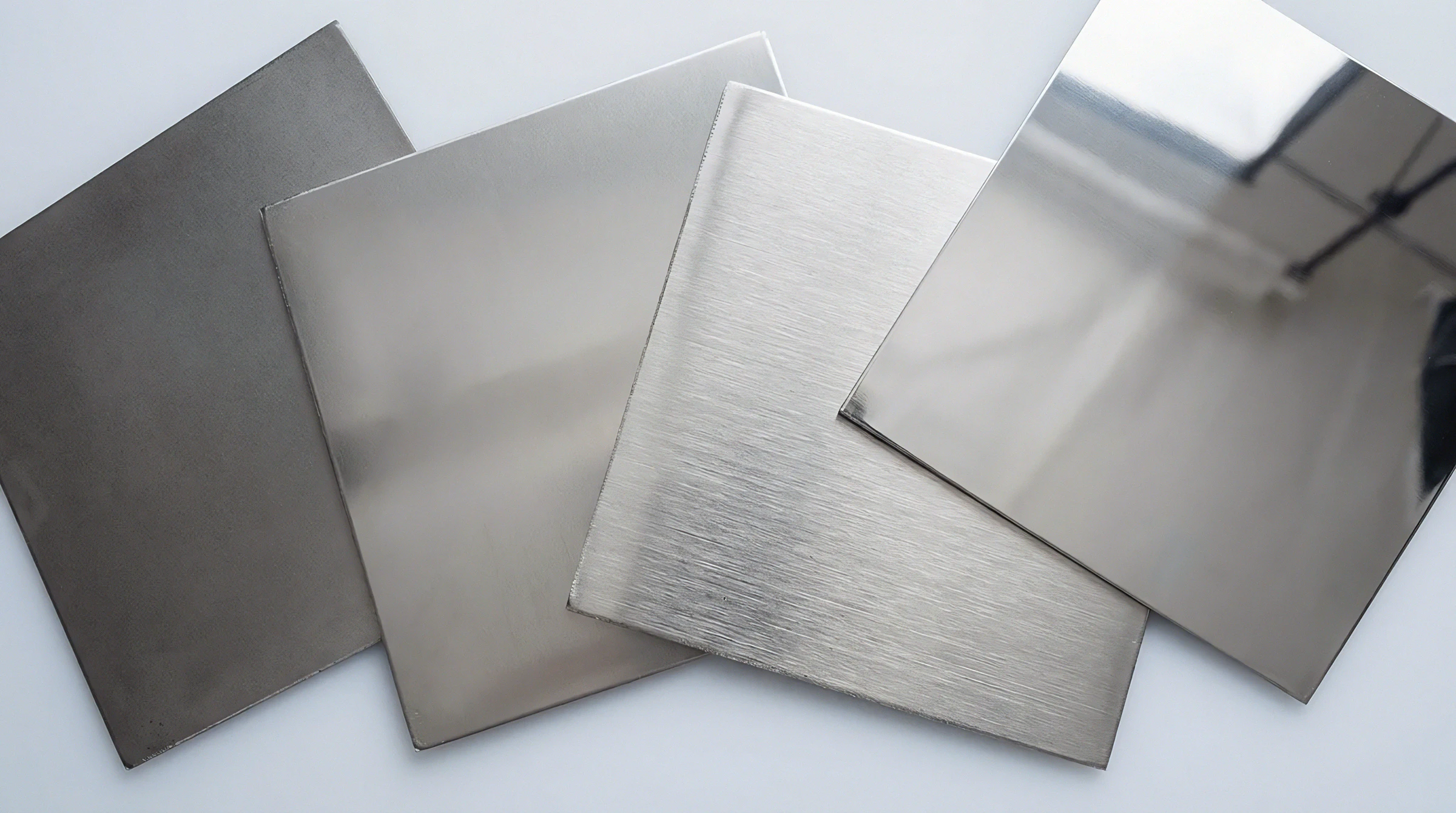
Euro Inox puts the typical roughness of a 2B stainless sheet at 0.30 to 0.50 µm Ra, and in the same publication it warns that a process tank delivered in a 2B finish above its specified maximum Ra has no repair procedure. Two sheets can carry the identical designation, come from different mills or different coils, and sit on either side of that limit. The code names a way of making the surface. It does not name how rough the result is.
EN 10088-2 is the European standard that lists those codes for stainless steel sheet, plate and strip, and most buyers meet it as two characters on a certificate.
What the Digit and the Letter in a Stainless Finish Code Mean
An EN 10088-2 designation is a digit followed by a letter. The digit says how the sheet was rolled: 1 for hot rolled, 2 for cold rolled. After it, the letter says what happened to the surface, so 2B is cold rolled and then heat treated, pickled and skin passed, while 1D is hot rolled, heat treated and pickled.
Euro Inox, which reproduces the table in its finishes guide, states the limit of the system plainly. It gives basic information on the processing sequence and description, but not on practical application. Its guide exists to fill that gap with detail on the processes and basic advice on use.
A second feature of the table shapes how it is read. Its notes say that not all process routes and finishes are available for all steel grades, that finishes ground, brushed, satin polished, bright polished, colored and coated are applied to one surface only unless agreed at enquiry and order, and that within each description the surface characteristics can vary so that grit grade or roughness may need to be agreed between maker and buyer.
An EN 10088-2 finish code records the processing sequence, hot or cold rolled and what was done to the face. Roughness, grit and which side is finished are separate agreements.
The Designations for Mill and Mechanical Finishes
Table 1 lists the designations that matter for cut and formed sheet, with the processing sequence and the notes as the Euro Inox guide prints them. Hot rolled finishes that keep mill scale, and cold worked or hardened grades, are left out of the table because sheet metal shops rarely meet them.
| Code | Processing sequence | Surface and notes | Ra where given |
|---|---|---|---|
| 1D | hot rolled, heat treated, pickled | rough and dull, free of scale; non-decorative uses such as unexposed supports | typically 3.50 to 7.50 µm |
| 2D | cold rolled, heat treated, pickled | smooth, matt, low reflectivity; good ductility, less smooth than 2B or 2R | not stated |
| 2B | cold rolled, heat treated, pickled, skin passed | smooth, reflective gray sheen; the most widely used finish; basis for most polished and brushed finishes | typically 0.30 to 0.50 µm |
| 2R | cold rolled, bright annealed | smooth, bright, highly reflective; easy to clean | not stated |
| 2G | ground | uniform, unidirectional, not very reflective; grit or roughness can be specified | not stated |
| 2J | brushed or dull polished | unidirectional, non-reflective; belt, brush or roughness can be specified | not stated |
| 2K | satin polish | J-type finish with added requirements for marine and external architectural use; transverse roughness | below 0.5 µm transverse |
| 2P | bright polished | non-directional, reflective, high image clarity, mechanically polished | not stated |
| 2F | cold rolled, heat treated, skin passed on roughened rolls | uniform non-reflective matt | not stated |
| 2M and 2W | pattern rolled on one side (2M) or two sides (2W) | stiffer sheet, hides scratches; design agreed | not stated |
The omitted codes mark the edges of the system. Codes 1U, 1C and 1E are hot rolled sheet that is not heat treated, heat treated but not descaled, or mechanically descaled, and the first two are covered with scale. Code 2H is cold worked for higher strength, 2C is cold rolled with heat treatment scale left on, 2E is mechanically descaled for steels whose scale resists pickling, and 2Q is hardened and tempered, scale free.
Three things in the table repay a second look. The code 2B is skin passed, a final light rolling with highly polished rolls, and that is what separates its sheen from 2D. Code 2R anneals in an oxygen-free atmosphere after cold rolling with polished rolls, which gives a brighter surface that Euro Inox says is less likely than any other mill finish to harbor airborne contaminants or moisture. And the J, K and P codes are mechanical finishes that sit on top of a mill finish, so the starting point matters: Euro Inox advises choosing the mill finish closest to the final look in order to minimize the extra steps.
Why a Designation Is Not a Roughness Value
The EN 10088-2 text says what path a sheet took. The Euro Inox roughness note adds the part buyers miss. Surface designations such as 2B or the ASTM No. 4 finish cover relatively large ranges of roughness, and products with identical designations from different batches or suppliers may have noticeably different characteristics.
The same note spells out how to write a roughness limit. Ra is the arithmetic average of the deviation of a surface trace from its centerline, measured in micrometers, and it does not separate peaks from valleys, so very different profiles can share a value. A limit written as Ra ≤ 0.6 µm is met if no more than 16 % of the measured values exceed it.
Written as Ra max 0.6 µm, the limit is met only if none do. The notation changes the pass rate, and the roughness note asks for the criterion to be stated explicitly.
For appearance work, Ra alone falls short. In architectural applications where look matters, Euro Inox recommends exchanging samples between customer and supplier and making them part of the purchase order. The reference samples should be held by each party, and the polishing specification may include a roughness Ra and inspection criteria.
- State Ra as “Ra ≤” or “Ra max,” never as a bare number.
- Attach a physical reference sample to the order when appearance matters.
- Say which face carries the finish, since most mechanical finishes are applied to one side only.
- Name the mill finish the mechanical finish starts from.
Grit, Ra and the ASTM Numbers Behind Brushed and Polished Finishes
Mechanical finishes are named by the abrasive that makes them, and the Euro Inox roughness note gives approximate values for the link. Table 2 lists them.
| Abrasive grit | Rq µm (µin) | Ra µm (µin) |
|---|---|---|
| 80 | 2.02 (80) | 1.80 (71) |
| 120 | 1.47 (58) | 1.32 (52) |
| 150 | 1.20 (47) | 1.06 (42) |
| 180 | 0.86 (34) | 0.76 (30) |
| 240 | 0.43 (17) | 0.38 (15) |
| 320 | 0.36 (14) | 0.30 (12) |
| 500 | 0.20 (8) | 0.18 (7) |
| 600 | 0.15 (6) | 0.13 (5) |
The ASTM A480 finish numbers that American drawings use map onto the same ground, with the Ra the Euro Inox note associates with each.
- A linear texture from mechanical polishing or rolling is No. 3, with an average Ra up to 1 µm (39 µin).
- Finer linear texture is No. 4, with an average Ra up to 0.6 µm (24 µin).
- Architectural finishes are No. 5, negotiated between buyer and seller, with transverse Ra not above 0.5 µm (20 µin).
- A soft satin from Tampico brushing of a No. 4 is No. 6, and a highly reflective finish made with finer abrasives and buffing is No. 8; the note gives no Ra for either.
The note adds the caution that its values are for orientation, that measurements differ with instruments, laboratories and operators, and that No. 3 and No. 4 can overlap. A grit-based callout is therefore a start, with the sample as the arbiter.
Euro Inox adds one more distinction in its finishes guide: wet finishes made with oil-faced emery are smoother and may be more consistent from batch to batch than dry finishes with grit belts or fiber brushes, though a minimum supply quantity can apply.
Blasted, Electropolished, Colored and Patterned Surfaces
Some finishes sit outside the numbered list, and the Euro Inox guide describes them separately. Bead blasting gives a uniform, non-directional, low-reflective surface, with materials including stainless particles, ceramic beads, aluminum oxide, shredded nut shells and glass. Iron or carbon steel shot is never to be used, because it contaminates the surface, and sand is not generally recommended.
Austenitic grades work harden during blasting, and the process can induce or relieve stress in a sheet or component, so blasting both sides may be needed to equalize it. The roughness note gives an Ra of 1.00 to 6.00 µm for bead blasted surfaces.
Electropolishing removes the peaks and troughs of the surface electrochemically. The result depends on the starting roughness and may not reach the mirror quality of mechanical polishing, and Euro Inox lists it as improving corrosion resistance and ease of cleaning. For electropolished surfaces, the roughness note gives Ra 0.10 to 0.80 µm.
Electrolytic coloring builds a transparent chromium oxide film, 0.02 to 0.36 µm thick as it passes through bronze, gold, red, purple, blue and green. Because no pigment is involved, the coloring survives bending, although the film thins at the bend and the color deepens less. The guide also states that stainless colored this way cannot be welded without destroying the colored surface, so welds on a colored part have to be planned before the coloring.
Patterned sheets, 2M on one side and 2W on both, are rolled with patterned rolls that stiffen the sheet, so thinner gauges can be used on large flat areas, and they hide knocks and scratches better than plain finishes.
Finish also affects how a sheet is joined to other parts. The Euro Inox guide notes that studs welded to the back of a sheet, a method used for attaching panels to a sub-frame, suit sheet at least 1 mm thick, need no weld clean-up and do not show through on the front face, although over-tightening thin gauge can pull through visual distortions. For adhesive bonding, a coarse finish gives a key for the adhesive, and pre-treatment such as degreasing, abrasives or chemical priming may still be needed. The guide asks that the stainless steel maker be consulted so that the right finish is supplied for the bond, since the finish decides what the adhesive has to hold.
Choosing a Finish by Exposure and Cleaning
The Euro Inox guide ties finishes to where the sheet will live. Code 1D is found on thicker sheet and plate and suits non-decorative parts such as unexposed supports. At the coarse end, 2G is restricted to interior use, and 2J is non-reflective and suited to interior architectural work. Finer, 2K, with its roughness ceiling of 0.5 µm, is the one the guide singles out for exteriors where atmospheric performance is critical, and 2P gives a mirror surface for adaptability, durability and low maintenance.
Grade comes first and finish second. The guide puts 316 (grade 1.4401) on coastal or heavy industrial sites and 304 (1.4301) in less demanding exteriors, so a fine finish on the wrong grade does not rescue a part from chlorides.
Cleaning changes the choice too. Rainwater helps clean stainless, so patterned or directional external finishes should run vertically to let it drain, and crevices and horizontal lines that collect airborne contaminants are best avoided. Routine washing with soap and water, a clean-water rinse and a dry cloth is generally enough.
Carbon steel abrasives such as wire wool, and materials containing chlorides, are never to be used, since either can damage the surface permanently. Where abrasive cleaning is necessary, the guide points to proprietary liquid cleaners or specialist contractors.
Pick the grade for the environment and the finish for the look and the cleaning. A 2K face on the wrong grade is still the wrong part for a coastal site.
What Bending, Cutting and Welding Do to a Finish
A finish is chosen for a flat sheet and then asked to survive the shop. Euro Inox sets down several practical rules. Tools for stainless should be kept only for stainless, to avoid carbon steel contamination.
A seam on a directional finish needs restoration at the welded junction, and the guide asks that the choice of finish be considered when selecting the weld process and the cleanup. The finish direction matters on large areas: mixed direction can look contrasting under some lighting, and suppliers can mark the rolling or processing direction on the underside of sheets or on the packaging.
Coils matter as much as direction. Where large areas of sheeting share one elevation, Euro Inox advises using coils from the same production batch, since color consistency can vary from batch to batch. A cut and bent enclosure with several panels is a small version of the same problem, and panels cut from two coils can read as two finishes beside each other.
Cutting, in turn, leaves its own surface. The thermal cut edge has its own Rz5 value under ISO 9013, which has no relation to the sheet’s finish designation, so a drawing needs a separate callout for the cut edge, the bent face and the face finish. A designation for the face does not describe an edge.
Writing the Finish Line on an Order
An order for finished stainless sheet should state the grade, the EN 10088-2 designation, the face that carries the finish, the roughness criterion and the reference sample. Table 3 turns that into a form.
| Line | Example wording | Where it is defined |
|---|---|---|
| Designation | 2B, or 2J with 240 grit | EN 10088-2 as reproduced by Euro Inox; roughness note |
| Roughness criterion | Ra max 0.5 µm, or Ra ≤ 0.5 µm | Euro Inox roughness note; EN ISO 4288 procedure it cites |
| Finished face | face A only, or both sides | notes to the EN 10088-2 table |
| Direction | grain along the long edge, direction marked on the underside or packaging | Euro Inox finishes guide, Annex A |
| Reference | sample sheet signed by both parties | Euro Inox finishes guide and roughness note |
| Weld zone | directional finish restored after welding | Euro Inox finishes guide, Annex A |
A first batch of cut and formed stainless panels belongs to low-volume sheet metal, and the finish line written for that batch is the one a later run of bridge production has to match panel for panel.
Sources and Further Reading
- Euro Inox, Guide to Stainless Steel Finishes, Building Series Volume 1, third edition 2005 (includes Annex B reproducing EN 10088-2 surface finishes)
- Euro Inox, Roughness Measurements of Stainless Steel Surfaces, 2014
- ISO, ISO 9013:2017, Thermal cutting, Classification of thermal cuts, Geometrical product specification and quality tolerances (SIS preview)