Filler

A filler is the wire or rod melted into a weld to add metal, chosen to match the base metal and the joint.

Every Filler article of the Sheet Metal Resources, newest first, each written from published standards, research and makers’ data.

Meaning

A filler is the wire or rod melted into a weld to add metal, chosen to match the base metal and the joint. Its classification appears on the weld procedure and often on the drawing. The wrong filler can crack, corrode or weaken the joint. Each alloy family has its common choices.

Stainless Fillers

Cleveland-Cliffs names AWS E/ER 308, 308L or 347 as the fillers most often specified for 304. For 316 it names AWS E/ER 316L or 16-8-2. It asks for ferrite in the weld deposit to avoid hot cracking. The 316L grade itself keeps carbon at 0.03 % maximum so the weld zone resists intergranular corrosion.
Read More

Aluminum Fillers

Lincoln Electric names 4043, 5554 or 5356 for 5052, with 5356 and 5554 the more common. The choice depends on the alloys being joined. A drawing names the filler for the alloy pair, not for the alloy alone.

Procedure Link

A welding procedure is qualified for a thickness band, and the filler is part of it. Cleveland-Cliffs lists published TIG procedures for 300 series stainless at 1.3 to 3.6 mm (0.050 to 0.14 in). A shop qualified on thin sheet holds a different qualification from one welding thick plate.

Heat and Size

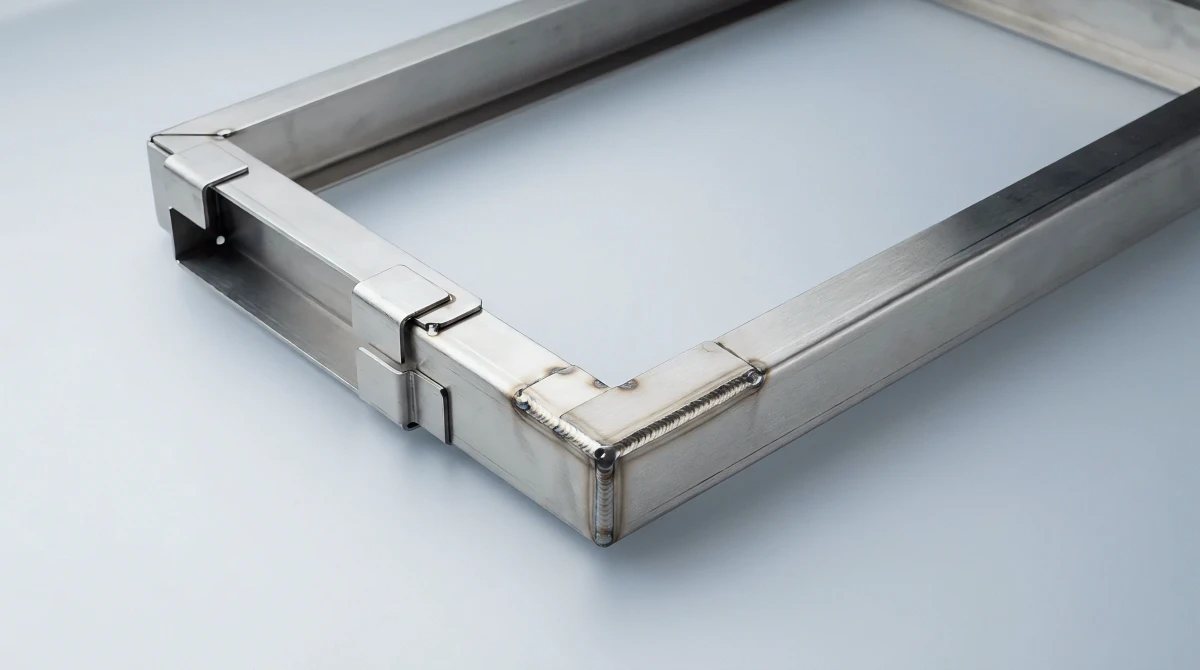
TWI keeps fillets to their specified minimum size, since extra weld metal adds shrinkage. Depositing filler quickly with the fewest runs also limits distortion. A fillet drawn larger than the load needs bends the panel for nothing. Cleveland-Cliffs adds that 316 needs a slower arc speed than 304. A thin 316 panel therefore takes more heat per length of seam.

5052 H32 Aluminum Sheet for Bending and Welding

Name the alloy, temper and specification, draw bend radii from a trial bend at the real thickness, and design welded joints to the annealed strength the weld leaves.

What 5052 H32 Offers a Bent and Welded Aluminum PartAlloy 5052 is an aluminum-magnesium alloy, registered in the United States in 1954. The Aluminum Association's international alloy register sets its composition: silicon 0.25 % maximum, iron 0.40 %, copper 0.10 %, manganese 0.10 %, magnesium 2.2 to 2.8 %, chromium 0.15 to 0.35 %, zinc 0.10 %, and 0.05 % each and 0.15 % in total for other elements, with aluminum the remainder.

316L Stainless Steel Sheet for Laser Cutting and Bending

Choose the molybdenum-bearing low-carbon grade for chloride exposure, plan overbend on the brake, and write the finish and weld tint rules on the drawing.

What 316L Sheet Adds Over 304L in a Cut and Bent PartType 316L is Type 316 with the carbon ceiling lowered from 0.08 % to 0.03 % by weight. Both carry 16.0 to 18.0 % chromium, 10.0 to 14.0 % nickel and 2.00 to 3.00 % molybdenum, according to the Cleveland-Cliffs product bulletin for the two types.

Request a Sheet Metal Quote

Send the 2D drawing and the 3D file, with the quantity and the stage of the project. An engineer replies within 1 working day.

The quote form, the mutual NDA and the private folder for your files are on Protolis Atelier, with Sheet Metal chosen.

Request a Quote